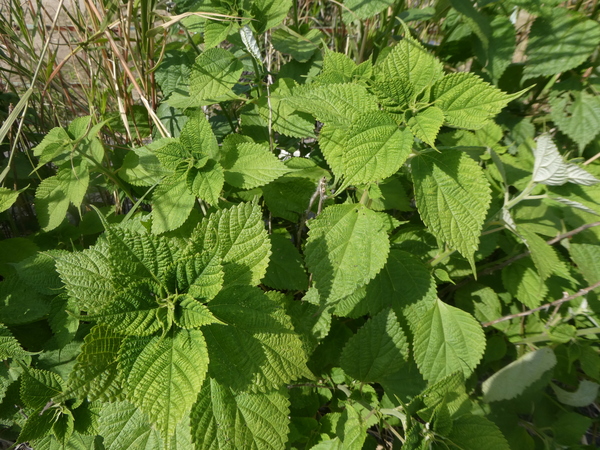
Japanese name: ナンバンカラムシ(南蛮茎蒸) Scientific name:Boehmeria nivea var. nivea
[Overview]
A perennial 1–2 m tall, found near human dwellings.
Compared with Karamushi, it tends to have thicker stems, taller plants, wider leaves and taller leaf teeth.
The stems, petioles and the veins on the underside of the leaves are densely covered with short hairs and spreading, coarse white hairs.
Leaves are simple and alternate, broadly ovate with a tail-like pointed tip, and the margin has regular teeth.
The underside of the leaf is densely covered with white cottony hairs and looks whitish.
There are male flowers and female flowers.
Male inflorescences arise from the leaf axils in the lower part of the stem and female inflorescences from those in the upper part, both being conical.
The fruit is an achene.
[History]
It is thought to have been cultivated for its fiber and then become wild.
[Uses]
It has long been cultivated for the fiber from the stem bark, which is used for weaving.