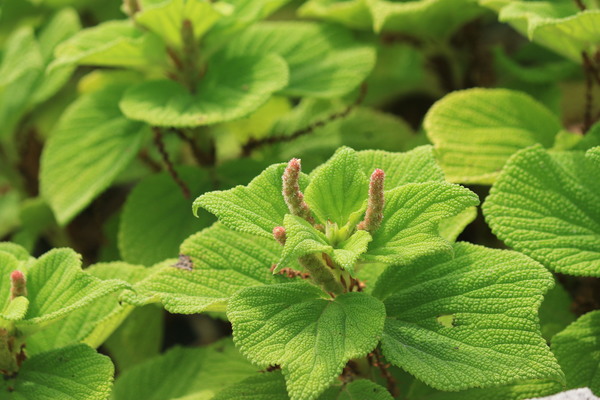
Japanese name: ラセイタソウ(羅背板草) Scientific name:Boehmeria biloba
[Overview]
A perennial 30–70 cm tall, found on coastal cliffs and among rocks.
The stems are thick, erect and clump-forming, making a large plant.
Leaves are simple and opposite, asymmetrical, broadly ovate-elliptic to obovate-round, 6–15 cm long, and often 2–3-lobed.
The leaves are thick, with short hairs on both sides and crinkled wrinkles on the upper surface.
The leaf margin has even, small, rounded teeth.
There are male and female flowers; the male inflorescences arise from the lower leaf axils of the stem and extend as spikes.
The female inflorescences arise from the upper leaf axils of the stem, are closely crowded together, and form spikes shorter than the leaves.
The fruit is an achene.
[Notes]
The Japanese name was given because the texture of the leaves resembles a woolen fabric called raxeta (Raxeta) in Portuguese.