
Plant Encyclopedia

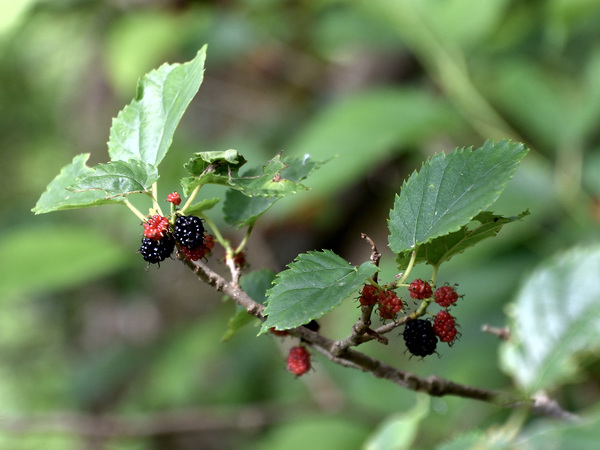
Morus australis (Korean mulberry, "Yamaguwa")
Japanese name: ヤマグワ (山桑)
Scientific name: Morus australis
[Overview]
A deciduous shrub to tree 3–10 m tall.
Young branches are hairless.
Leaves are alternate, elliptical, 6–14 cm long and 4–7 cm wide, either undivided or deeply 3–5-lobed.
Short hairs grow on the veins on both the upper and lower surfaces of the leaf, and soft hairs grow at the base of the lateral veins on the underside.
The leaf margin has teeth.
The petiole is 2–3.5 cm long and hairless.
The stipules are lanceolate.
It is dioecious or monoecious.
Catkins arise from the lower leaf axils of young branches and from the axils of scale leaves.
The male catkin is 2 cm long, and its stalk is 1 cm long with coarse hairs.
The female catkin is 0.4–0.6 cm long, and its stalk is 0.4–1 cm long with coarse hairs.
Both male and female flowers are small and inconspicuous.
The fruit is an elliptical aggregate fruit that ripens purplish black.
The styles remaining on the fruit are long and conspicuous.
The fruit is sweet and edible.
[Uses]
The root bark is used medicinally.
[Cultivation]
Propagate by cuttings.
It prefers sunny, well-drained soil.
Rainfall is sufficient for watering unless sunny weather continues and the soil becomes severely dry.
Apply organic fertilizer in winter, and place fast-acting chemical fertilizer on the soil in spring and after flowering as a thank-you fertilizer.
Pests and diseases include atrophy disease, bacterial leaf curl, powdery mildew, leaf soiling disease, white root rot, Kuwa-no-meiga (mulberry pyralid), Amerika-shirohitori (fall webworm), Kuwa-gomadara-hitori and teppomushi (longhorn beetle larvae).
Details
Japanese: ヤマグワ(山桑)、シマグワ(島桑)、アマミグワ(奄美桑)
Translated from our Japanese encyclopedia. If anything differs, the Japanese page is correct.