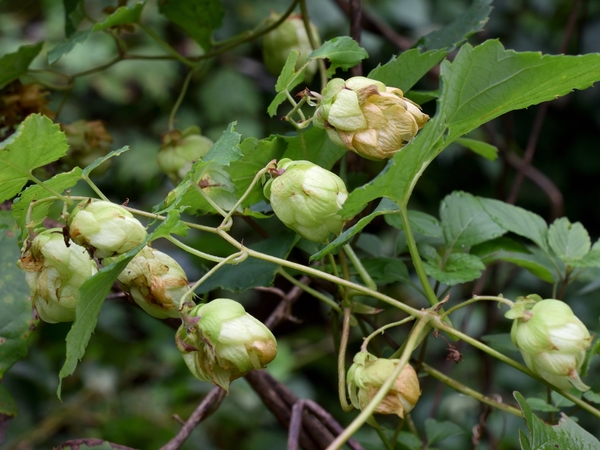
Japanese name: カラハナソウ(唐花草) Scientific name:Humulus lupulus var. cordifolius
[Overview]
A climbing perennial found in the mountains.
It has underground rhizomes.
The stems and petioles have downward-pointing bristles.
The leaves are opposite, ovate-orbicular, 5–12 cm long, and are either simple or palmately divided into 3–5 lobes.
The leaf margins have coarse serrations.
The petioles are long.
The plant is dioecious.
The male inflorescences arise from the upper leaf axils and are conical, made up of clustered cymes.
The male flowers are small and yellowish white, and the corolla is 5-lobed.
The female inflorescences arise from the upper leaf axils; they are made up of clustered dichasia, forming ovate-orbicular inflorescences 2–3 cm long that hang down.
The female flowers have no petals and are enclosed in membranous, dry bracts.
The bracts are ovate-elliptic, do not curl back even at the fruiting stage, and take on a yellowish brown color when dry.
The fruit is an achene, and its surface has bitter yellow glandular dots.
[Uses]
The flower spikes are used as a substitute for hops, and the fruit spikes are also used medicinally.