
Plant Encyclopedia

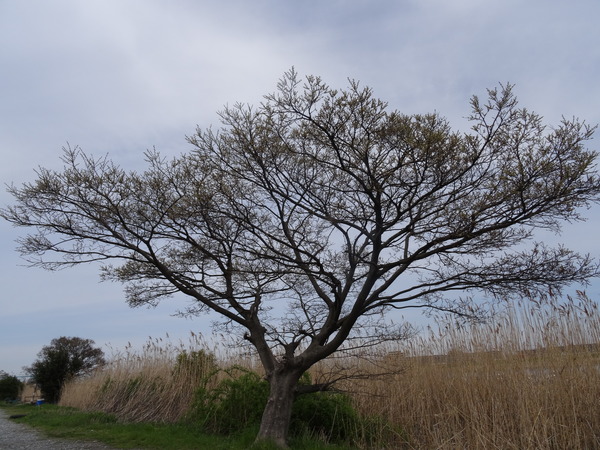
Celtis sinensis (Chinese hackberry, "Enoki")
Japanese name: エノキ (榎)
Scientific name: Celtis sinensis
[Overview]
A deciduous tree 20–25 m tall and up to 1 m in diameter, found on slopes with fertile soil along valleys and similar places.
The branches spread horizontally and branch often, forming an umbrella-shaped crown.
The leaves are simple and alternate, broadly elliptic to broadly ovate-elliptic, 4–9 cm long, and asymmetrical.
Usually there are a few serrations on the upper half of the leaf.
Three veins arise from the base of the leaf.
The leaf texture is rather hard and thick, and the upper surface is glossy.
The leaves turn yellow in autumn.
There are male flowers and bisexual flowers; the male flowers form cymes on the lower part of young branches and are small and 4-petaled.
The bisexual flowers grow singly or in bundles of 2–3 in the upper leaf axils of young branches.
The fruit is a spherical drupe about 6 mm across, ripening reddish orange.
The fruit is sweet and edible.
Wild birds like the fruits.
[Uses]
The wood is used for construction, utensils, and firewood and charcoal.
There is a game called "enomi-teppo" in which the fruits are packed into a bamboo tube and shot out.
Since ancient times it has been regarded as a tree with spiritual power and has been planted in the grounds of temples and shrines.
Because it is sturdy and grows into a large tree, it was planted at ichirizuka (roadside mile markers) along highways, and traces of this can still be seen in various places today.
[Cultivation]
Propagate from seed or by grafting.
The germination rate of the seeds drops sharply when they dry out, so when growing from seed, collect ripe fruits, wash off the flesh well with water, and sow immediately.
The suitable planting area is the southern Tohoku region and south.
It prefers a moist environment in sun to partial shade, but grows well in any type of soil.
It becomes a large tree and needs plenty of space.
When planted in the ground, no watering is particularly needed once it has taken root.
There are no particular pests or diseases, but larvae of longhorn beetles (teppo-mushi) may bore into it.
[Notes]
It is a food plant for the larvae of Omurasaki and Gomadara-cho.
Details
Japanese: エノキ(榎)、ナガバエノキ(長葉榎)、マルバエノキ(丸葉榎)
Translated from our Japanese encyclopedia. If anything differs, the Japanese page is correct.