
Plant Encyclopedia

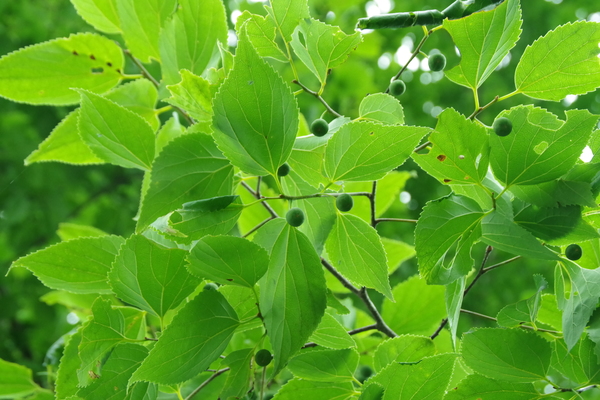
Celtis jessoensis (Japanese hackberry, "Ezoenoki")
Japanese name: エゾエノキ (蝦夷榎)
Scientific name: Celtis jessoensis
[Overview]
A deciduous tree 20–30 m tall and up to 0.6 m in diameter, found along valleys in the mountains.
The leaves are simple and alternate in two rows, ovate to ovate-elliptic, 6–10 cm long, asymmetrical, with a tail-like pointed tip.
Except at the base, the leaf has sharp, wavy serrations.
Three veins arise from the base of the leaf.
The leaf texture is rather thin, both surfaces are slightly rough, and the upper surface is somewhat glossy.
The petiole is 0.5–1 cm long and densely covered with short white hairs while the leaves are young.
The leaves turn yellow in autumn.
There are male flowers and bisexual flowers; the male flowers grow in bundles of several on leafless short shoots or on the lower part of leafy branches, and the bisexual flowers grow singly in the axils of upper bracts or leaves.
The flowers are small, 4-petaled, and have long stalks.
The fruit is a spherical drupe about 6 mm across, ripening black.
[Cultivation]
Propagate from seed or by grafting.
The germination rate of the seeds drops sharply when they dry out, so when growing from seed, collect ripe fruits, wash off the flesh well with water, and sow immediately.
It prefers a moist environment in sun to partial shade, but grows well in any type of soil.
It becomes a large tree and needs plenty of space.
When planted in the ground, no watering is particularly needed once it has taken root.
There are no particular pests or diseases, but larvae of longhorn beetles (teppo-mushi) may bore into it.
Details
Japanese: エゾエノキ(蝦夷榎)、オクエノキ
Translated from our Japanese encyclopedia. If anything differs, the Japanese page is correct.