
Plant Encyclopedia

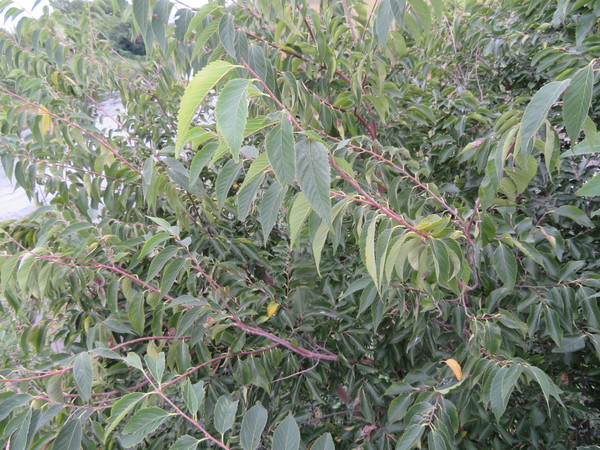
Aphananthe aspera (scabrous aphananthe)
Japanese name: ムクノキ (椋木)
Scientific name: Aphananthe aspera
[Overview]
A deciduous tree 20–25 m tall and up to 1 m in diameter, found on slopes with fertile soil along valleys.
The bark of young trees is gray-brown and smooth, but later becomes marked with gray and brown vertical stripes, and on old trees it peels off in fine scales.
Old trees may develop buttress roots at the base.
The leaves are simple and alternate in two rows, ovate-elliptic, with regular teeth except at the base.
Three veins arise from the base of the leaf.
Both surfaces have stiff hairs and are rough.
The leaves turn yellow in autumn.
There are male and female flowers; the male flowers form cymes at the base of young twigs, are about 5 mm across, and have 5 sepals and 5 stamens.
The female flowers grow in ones or twos in the leaf axils at the top of young twigs.
The fruit is a spherical drupe that ripens to blackish purple.
The fruit is sweet and edible.
Wild birds like the fruit.
[Uses]
The wood is tough and is used for construction and for utensils.
The leaves are used for polishing ivory, tortoiseshell, and wooden bases.
The flowers and root bark are used medicinally.
[Cultivation]
Propagate from seed.
The germination rate of the seeds drops sharply when they dry out, so collect ripe fruits, wash off the pulp thoroughly with water, and sow immediately.
It prefers a sunny, moist environment, but grows well regardless of soil type.
It becomes a large tree, so it needs plenty of space.
For plants in the ground, no watering is particularly necessary once they are established.
There are no particular pests or diseases.
Details
Japanese: ムクノキ(椋木)、ムク(椋)、ムクエノキ(椋榎)
Translated from our Japanese encyclopedia. If anything differs, the Japanese page is correct.