
Plant Encyclopedia

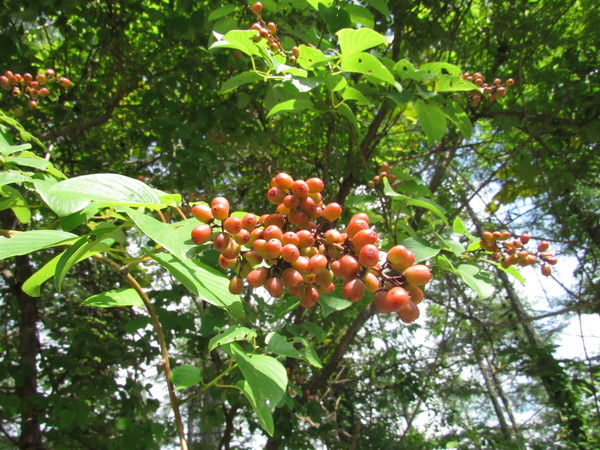
Berchemia racemosa var. racemosa (paniculous supplejack, "Kumayanagi")
Japanese name: クマヤナギ (熊柳)
Scientific name: Berchemia racemosa var. racemosa
[Overview]
A deciduous climbing shrub found in hills and mountains.
Young branches are yellow-green, and the lateral branches spread widely at right angles.
Leaves are simple and alternate, ovate to oblong, 4–6 cm long and 2–4 cm wide, with 7–8 pairs of conspicuous pinnate lateral veins.
The underside of the leaf is whitish.
The leaf margin is entire.
The petiole is 0.7–1.5 cm long.
The leaves turn yellow in autumn.
The flowers are small, yellow-green and 5-petaled, and are borne in large numbers in large inflorescences at the branch tips.
The fruit is an elliptic drupe 0.5–0.7 cm long that ripens in summer of the following year, changing from yellow to red and finally to black.
Fruits and flowers can be seen at the same time.
[Uses]
The fruit is sweet and edible.
The young leaves are also edible.
The stems and leaves are used medicinally.
The vines were once used as material for horse whips and wakanjiki (ring-shaped snowshoes).
[Cultivation]
Propagate from seed or by cuttings.
It prefers well-drained soil in sun to partial shade.
From spring to autumn, water thoroughly when the soil surface dries, and in winter too, do not let the soil dry out completely.
If fertilizer is applied at planting, no further fertilizing is particularly necessary, but organic fertilizer may be applied in early spring.
There are no particular pests or diseases.
Details
Japanese: クマヤナギ(熊柳)、クロガネカズラ(黒鉄葛)、クマフジ(熊藤)、イボタヤナギ、トウヅラ、トンヅラ、クマコヅル
Translated from our Japanese encyclopedia. If anything differs, the Japanese page is correct.