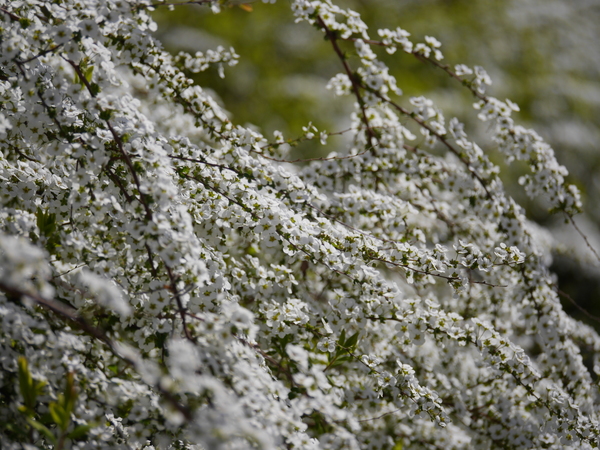
Japanese name: ユキヤナギ(雪柳) Scientific name:Spiraea thunbergii
[Overview]
A deciduous shrub 1–2 m tall, found on cliffs and rocky gravelly ground along mountain rivers.
The young branches are brown and densely hairy.
The branches are slender and extend long in an arch.
Leaves are simple and alternate, linear-lanceolate, 2–4 cm long and 3–7 cm wide, with serrated margins.
Umbel-like corymbs on the previous year's branches bear 2–7 white 5-petaled flowers each, 8 mm across.
The flowers have 20 stamens shorter than the petals.
Many inflorescences form, and the flowers are so numerous that they cover the whole plant in white.
The fruit is a follicle.
[Uses]
In China, the root is used as a folk medicine.
[Cultivation]
Propagate from seed or by cuttings.
It prefers a sunny, well-drained soil rich in humus.
For potted plants, water thoroughly when the soil surface dries; for plants in the ground, rainfall is sufficient unless summer brings a long spell of sunny weather and the soil becomes severely dry.
For potted plants, place slow-release fertilizer on the soil in spring; for plants in the ground, none is particularly needed.
Pests and diseases include powdery mildew and scale insects.