
Plant Encyclopedia

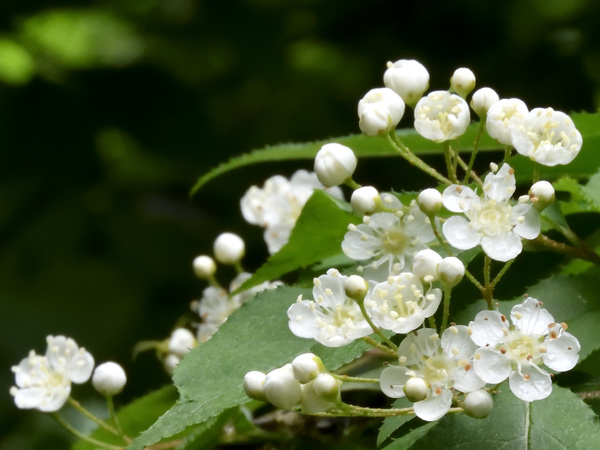
Pourthiaea villosa var. villosa ("Kamatsuka")
Japanese name: カマツカ (鎌柄)
Scientific name: Pourthiaea villosa var. villosa
[Overview]
A deciduous shrub or small tree 3–4 m tall, found in forests and at forest edges in hills and low mountains.
At flowering time, long white hairs grow on the young branches, petioles, the main veins on the undersides of the leaves, and the flower stalks and inflorescence stalks, but they almost disappear after flowering.
The leaves are simple and alternate, obovate, 4–12 cm long and 2–6 cm wide, with a short protruding tip.
The leaf margins have small, sharp teeth.
On short shoots the leaves appear whorled to clustered.
The petiole is 0.2–1 cm long.
Compound corymbs at the branch tips bear 10–20 white flowers with 5 petals.
The flowers are about 1–1.3 cm across, with rounded petals that have a short claw at the base.
There are 20 stamens.
The inflorescence stalk is 3–5 cm long, and wart-like lenticels become conspicuous when in fruit.
The fruit is an elliptic pome 0.8–1 cm long that ripens red; it is sweet and edible.
[Uses]
The wood is strong and elastic, so it was used as material for tools such as sickle handles.
The young shoots and fruits are edible, and the fruits are also used for fruit liquor.
The bark and leaves are used as dye.
The roots are used medicinally.
[Cultivation]
Propagate from cuttings or seed.
The germination rate falls if the seeds dry out, so harvest ripe fruits, wash off the pulp, bury the seeds in moistened vermiculite or similar so they do not dry out, store them in a cool, dark place, take them out the following spring, and wash them thoroughly once more before sowing.
It prefers well-drained soil in sun to partial shade.
For potted plants, water thoroughly when the soil surface dries; for plants in the ground, rainfall is sufficient.
Apply organic fertilizer in winter, and also apply slow-release chemical fertilizer placed on the soil as fertilizer after flowering.
There are no particular pests or diseases.
[Notes]
The Japanese name comes from its use as material for sickle handles.
The alternative name Ushikoroshi comes from its use as material for cattle nose rings.
Details
Translated from our Japanese encyclopedia. If anything differs, the Japanese page is correct.