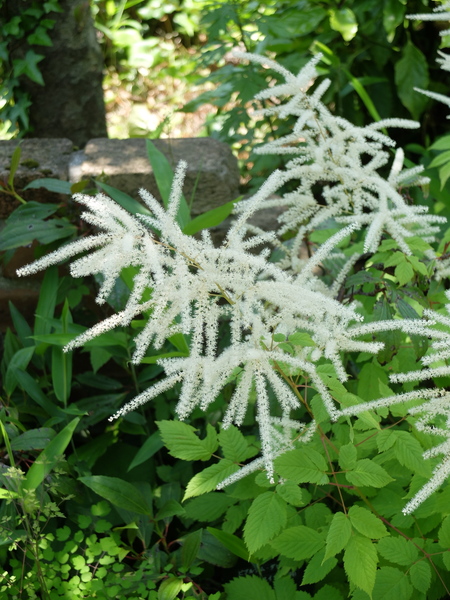
Aruncus dioicus var. kamtschaticus("Yamabukishoma")
Japanese name: ヤマブキショウマ(山吹升麻) Scientific name:Aruncus dioicus var. kamtschaticus
[Overview]
A perennial 30–100 cm tall, found in grasslands and forest edges in the mountains.
It has thick, branching rhizomes.
The leaves are alternate and 2–3 times ternately compound.
The leaflets are narrowly ovate to ovate-round, 3–10 cm long and 1–6 cm wide, with distinct parallel lateral veins.
The leaf margin has notched double teeth.
It is dioecious.
Compound racemose panicles 10–30 cm long at the stem tips bear many small white 5-petaled flowers.
The male flowers have about 20 long stamens.
The flower stalks have short hairs.
The fruit is a glossy follicle, usually pointing downward, which splits open to release fine seeds.
[Uses]
The young shoots are eaten as wild vegetables.
The rhizomes are used medicinally.
[Cultivation]
Propagate from seed or by division.
It prefers well-drained soil in sun to partial shade.
Take care not to let it dry out; for potted plants, water thoroughly when the soil surface dries, and for plants in the ground, rainfall is sufficient.
In spring, place organic fertilizer on the soil.
There are no particular pests or diseases.
[Notes]
The Japanese name derives from the leaflet shape resembling Yamabuki and the plant's habit resembling Toriashi-shoma.