
Plant Encyclopedia

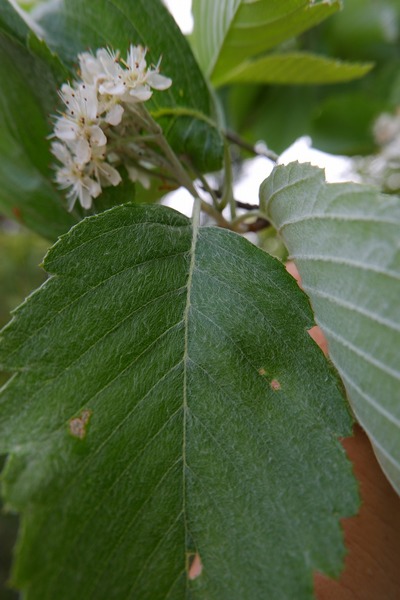
Aria japonica ("Urajironoki")
Japanese name: ウラジロノキ (裏白木)
Scientific name: Aria japonica
[Overview]
A deciduous tree up to 20 m tall, found in sunny places such as near ridges from the mountains to the subalpine zone.
First-year branches are densely covered with white cottony hairs, but in the second year they become almost hairless and purplish black.
The leaves are simple and alternate, ovate-round to broadly obovate, 6–12 cm long and 4–9 cm wide.
There are 8–11 pairs of lateral veins, which are very conspicuous, run almost straight to the tips of the teeth, and protrude on the underside.
The underside of the leaf is densely covered with white cottony hairs, and the whiteness is conspicuous even in fallen leaves.
The leaf margin has large triangular double teeth.
The petiole is 1–2 cm long and densely covered with white cottony hairs.
The leaves turn yellow in autumn.
Compound corymbs at the tips of short shoots bear inflorescences densely covered with white cottony hairs.
The flowers are white, 5-petaled, and 1–1.5 cm across.
The petals are round and spread open.
There are 20 stamens and 2 styles.
The fruit is an obovate-elliptic pome 0.9–1.4 cm long and 0.8–1.1 cm wide, ripening red, with conspicuous lenticels.
[Uses]
The wood is hard and is used for construction, furniture and utensils.
[Cultivation]
Propagate from seed or by cuttings.
It prefers fertile soil in a sunny, well-drained place.
It dislikes strong afternoon sun.
For potted plants, water thoroughly when the soil surface dries; for plants in the ground, rainfall is sufficient unless summer brings a long sunny spell and the soil dries out.
Apply organic fertilizer around the plant in winter.
There are no particular pests or diseases.
Details
Translated from our Japanese encyclopedia. If anything differs, the Japanese page is correct.