
Plant Encyclopedia

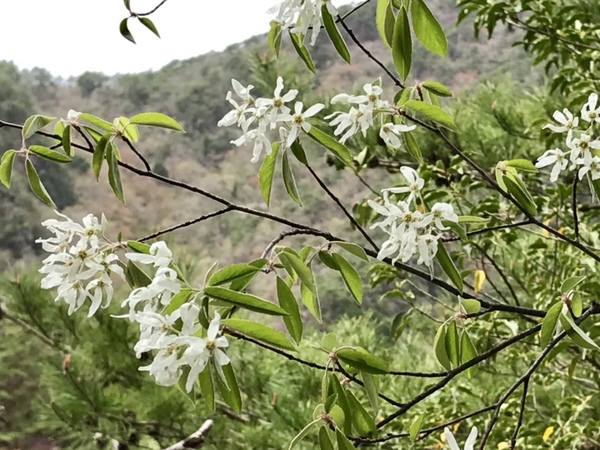
Amelanchier asiatica (Korean juneberry, "Zaifuriboku")
Japanese name: ザイフリボク (采振木)
Scientific name: Amelanchier asiatica
[Overview]
A deciduous shrub to tree that can reach about 12 m in height.
Young branches have white to grayish-white soft hairs.
Leaves are simple and alternate, obovate to elliptic, 4–9 cm long and 2.5–4 cm wide, with fine serrations on the margin.
The leaves are at first densely covered with white cottony hairs, but later become almost hairless.
The petiole is 1–2.5 cm long and covered with white soft hairs.
There are linear stipules 8–12 mm long that fall off early.
Racemes 4–7 cm long at the branch tips bear about 10 flowers.
The flowers are white and 5-petaled, and the petals are slender, 15 mm long and 5 mm wide.
There are about 20 stamens, and the 5 styles are fused at the base.
The fruit is a spherical pome 6–10 mm across, ripening purplish black in early summer, with the calyx lobes remaining like a crown.
[Cultivation]
Propagate from seed, by cuttings, or by layering.
When propagating from seed, stratifying the seeds improves the germination rate.
It prefers a sunny site and dislikes dryness.
It is hardy and not particular about soil.
It grows large, so it is suited to planting in the garden.
For garden plants, watering is unnecessary unless the weather stays very dry.
For potted plants, water thoroughly when the soil surface dries.
In winter, apply slow-release chemical fertilizer or oil cake as fertilizer in winter.
Pests and diseases include fire blight, slug caterpillars, aphids and longhorn beetles.
[Notes]
The Japanese name compares the shape of the flower to a saihai (a commander's baton).
Details
Japanese: ザイフリボク(采振木)、シデザクラ(四手桜)
Translated from our Japanese encyclopedia. If anything differs, the Japanese page is correct.