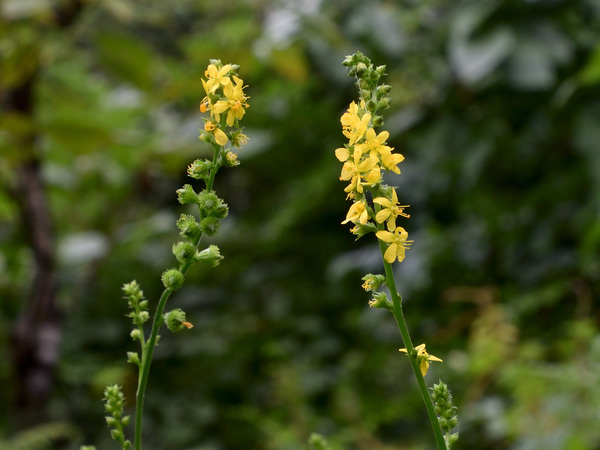
Japanese name: キンミズヒキ(金水引) Scientific name:Agrimonia pilosa ver. japonica
[Overview]
A perennial 50–100 cm tall, commonly seen in hills and fields.
It has a thickened rhizome.
The stems are branched and densely hairy.
Leaves are alternate and odd-pinnately compound, with 5–9 leaflets.
The leaflets are rhombic-oblong to obovate with pointed tips, and the margins have coarse teeth.
The underside of the leaf has many white glandular dots.
The stipules are half-ovate and serrated.
Racemes at the stem tips bear fairly dense flowers.
The flowers are yellow, 5-petaled, and 7–10 mm across.
The petals are obovate, 3–6 mm long and 1.5–2 mm wide.
There are 8–14 stamens.
The receptacle tube in fruit is obconical, 5–6 mm long and 4–5 mm across, and has hooked spines 3 mm long on its upper rim; the fruit is carried by animals that these spines catch on.
[Uses]
The whole plant is used medicinally.
[Cultivation]
Propagate by division or from seed.
It prefers a well-drained, airy site in sun to partial shade.
It is easy to grow.
There are no particular pests or diseases.
[Notes]
Hime-kinmizuhiki can be distinguished by its fewer leaflets (3–5), leaflet tips that are not very pointed, smaller flowers 5–7 mm across, narrower petals, and fewer stamens (5–8).