EVERGREEN

Plant Encyclopedia

Thermopsis lupinoides

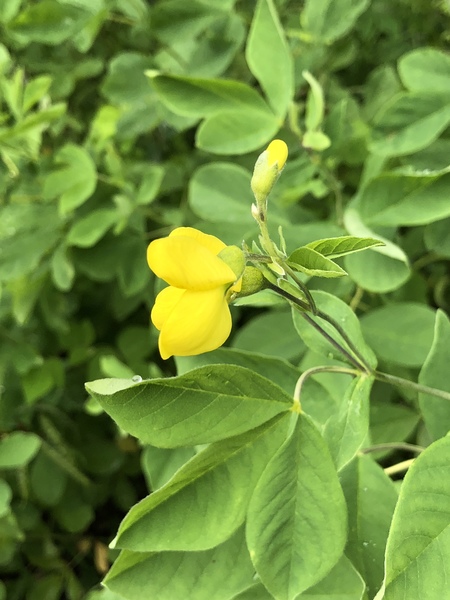
Thermopsis lupinoides ("Sendaihagi")

Japanese name: センダイハギ (仙台萩、千代萩、先代萩)
Scientific name: Thermopsis lupinoides

Thermopsis lupinoides

[Overview]
A perennial 40–80 cm tall, growing on coastal shores in the north.
It has thick underground stems.
The leaves are alternate and trifoliate, with ovate leaflets 5–7 cm long that have white soft hairs on the underside.
The stipules are large, 3–4 cm long, and attached at the base of the leaf stalk.
Pseudoracemes at the stem tips bear yellow papilionaceous flowers.
The bracts are elliptical to ovate with white soft hairs.
The fruit is a slender legume 7–11 cm long containing 10–15 seeds.

[Cultivation]
Propagate from seed or by division.
It prefers a sunny, well-drained site.
Cultivation is easy.
Rainfall is sufficient for watering.
Fertilize sparingly; if fertilizer is applied at planting, none is particularly needed.
There are no particular pests or diseases.

[Notes]
The name is said to derive from the kabuki play Meiboku Sendai Hagi.

Details

Names
Japanese: センダイハギ(仙台萩、千代萩、先代萩)
Life form
Perennial
Habit
Terrestrial
Planting (or sowing) season
March, April, September, October
Flowering season
May, June, July, August
Distribution or origin
Japan (Hokkaido, Honshu from central part northward), Korea, China, Russian Far East, northern North America
Height
400–800 mm
Leaf shape
Trifoliate compound leaf
Leaf arrangement
Alternate
Inflorescence
Pseudoraceme
Flower color
Yellow
Leaf color
Green
Availability of seeds and plants
Low
Form sold
Seedlings
Propagation
Seed, Division
Sun exposure
Full sun
Water needs
Moderate
Soil needs
Required
Tolerance
Cold tolerance, Drought tolerance, Salt-spray tolerance
Suitable uses
Flower bed, Parks and gardens
Japan Flower Trade Code
14354

Translated from our Japanese encyclopedia. If anything differs, the Japanese page is correct.

Sponsored