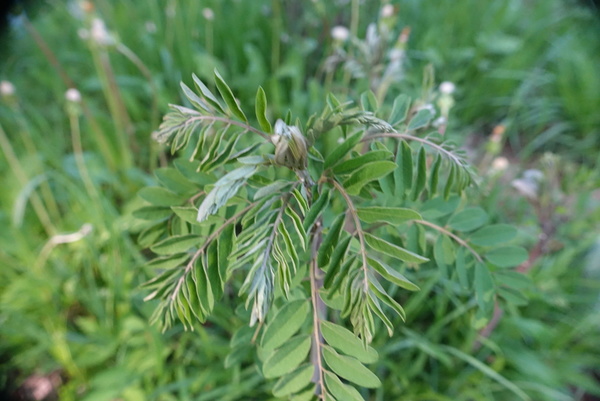
Japanese name: クララ(眩草) Scientific name:Sophora flavescens
[Overview]
A perennial 80–150 cm tall, seen on sunny riverbeds and grasslands.
The stem is branched and becomes woody at the base.
The stem has short brown hairs.
The leaves are alternate and odd-pinnately compound, 15–25 cm long, consisting of 15–41 leaflets.
The leaflets are oblong to narrowly ovate, 2–4 cm long and 0.7–1.5 cm wide, and hairy on both sides.
The petiole has short brown hairs.
Racemes at the stem tips bear many pale yellow pea-shaped flowers 1.5–1.8 cm long.
The flower stalks have short brown hairs.
The fruit is a slender legume 7–8 cm long containing 4–5 seeds, constricted between the seeds so that it looks like a string of beads.
[Uses]
It is poisonous, but the root is used medicinally.
[Cultivation]
Propagate from seed.
It prefers sunny, well-drained soil.
If the conditions suit it, it grows well even when left alone.
Rainfall is sufficient for watering.
Fertilizer is not particularly necessary, but slow-release fertilizer may be placed on the soil during the growing season.
There are no particular pests or diseases.
[Notes]
The Japanese name derives from the fact that chewing the root is so bitter that it makes one dizzy.