
Plant Encyclopedia

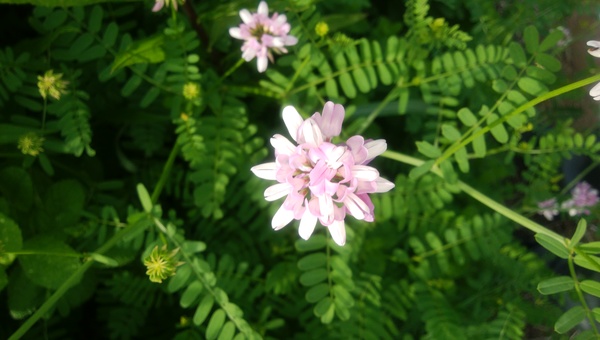
Securigera varia (crownvetch, "Tamazakikusafuji")
Japanese name: タマザキクサフジ (玉咲草藤)
Scientific name: Securigera varia
[Overview]
A perennial.
The whole plant is hairless; the stems branch freely and creep or rise obliquely, extending like vines up to about 1 m long, and the plant is 0.3–1 m tall.
The leaves are alternate and odd-pinnately compound.
There are 15–25 leaflets, elliptic, 0.6–2 cm long, with entire margins; the lowest pair often curves backward as if clasping the stem.
The stipules are small.
An umbel is borne at the tip of an inflorescence stalk 5–7 cm long arising from the leaf axil, with 10–20 pea-shaped flowers clustered into a ball.
The flowers are 1–1.5 cm long and pink to white, with the standard petal darker in color.
The fruit is a slender legume 2–6 cm long, square in cross section, divided into 3–12 segments.
[History]
It was introduced from Europe after World War II for use as forage and similar purposes.
It was first recorded in 1981 in Hiroshima-cho, Hokkaido (now Kitahiroshima), and naturalization has also been confirmed in the Kanto and Chugoku regions.
[Uses]
It is used as fodder and green manure.
[Cultivation]
Propagate from seed or by division; it also spreads readily from self-sown seed.
It prefers a sunny, well-drained site and is easy to grow.
Details
Japanese: タマザキクサフジ(玉咲草藤)、タマザキフジ(玉咲藤)、クラウンベッチ
Translated from our Japanese encyclopedia. If anything differs, the Japanese page is correct.