
Plant Encyclopedia

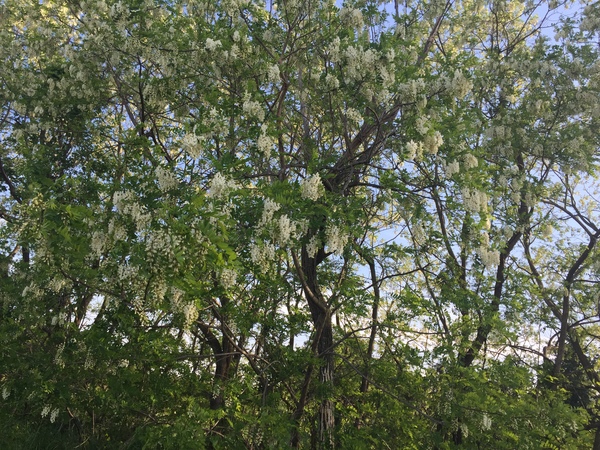
Robinia pseudoacacia f. inermis ("Togenashiharienju")
Japanese name: トゲナシハリエンジュ (刺無針槐)
Scientific name: Robinia pseudoacacia f. inermis
[Overview]
A thornless deciduous tree growing to 25 m tall.
The leaves are alternate and odd-pinnately compound, with 5–10 pairs of lateral leaflets.
The leaflets are elliptic, 2.5–5 cm long, with pressed hairs on both surfaces and entire margins.
False racemes hang down from the leaf axils and bear dense flowers.
The flowers are white and pea-shaped, about 2 cm long, with yellow spots on the standard petal.
The flowers are fragrant.
The fruit is a legume 5–10 cm long and 1.5–1.8 cm wide, containing 3–10 seeds; unlike Enju, it is not constricted.
[Uses]
It is used as a street tree and for erosion control.
It is famous as a honey plant, and "acacia honey" refers to honey from this plant.
The flowers are used medicinally and are also eaten as tempura.
[Cultivation]
Propagate from seed, by grafting, or by root cuttings.
As long as the site is sunny, it is not particular about soil.
It is better suited to a somewhat dry site, but is adaptable.
If the conditions suit it, it grows well even if left alone once established.
The roots are shallow, so large trees may be blown over or have their trunks broken by strong winds.
For potted plants, water thoroughly when the soil surface dries; for plants in the ground, rainfall is sufficient.
Fertilizer is not particularly necessary, since it can synthesize nitrogen through root nodule bacteria.
Pests and diseases include canker, anthracnose, powdery mildew, brown spot, fall webworm, aphids and teppo-mushi (longhorn beetle larvae).
Details
Translated from our Japanese encyclopedia. If anything differs, the Japanese page is correct.