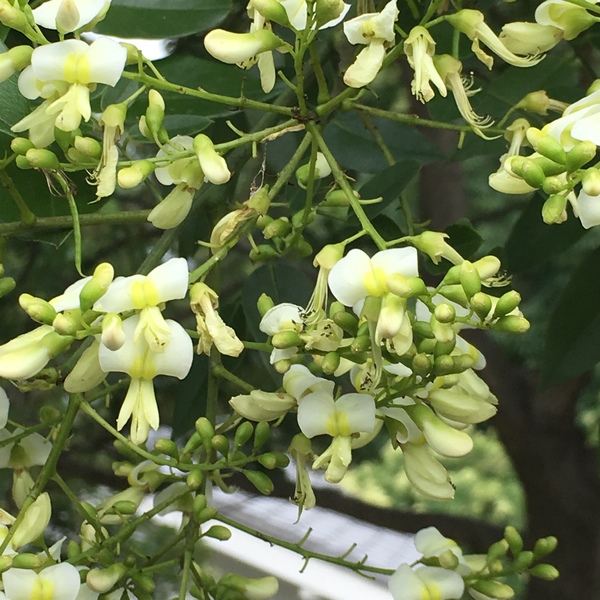
Japanese name: エンジュ(槐) Scientific name:Styphonolobium japonicum
[Overview]
A deciduous tree growing to more than 20 m tall. The bark develops irregular vertical fissures and is grayish dark brown.
Young branches are green.
The leaves are alternate and odd-pinnately compound, 15–20 cm long, with a swollen leaf-stalk base. There are 7–13 leaflets, each elliptic to ovate, 3–4.5 cm long, with entire margins; the undersides have white appressed hairs and so look whitish.
Many flowers are borne in panicles at the branch tips and bloom in July–August. The corolla is a pale cream papilionaceous (butterfly-shaped) flower.
The fruit is a legume 3–7 cm long, constricted like a string of beads, ripening to an amber color.
[Uses]
In addition to being useful as a nectar source plant, the buds are used medicinally and to dye silk yellow. The pods are said to have been used as a substitute for soap.
[Cultivation]
Propagate from seed.
It prefers sunny, well-drained, slightly moist land.
It is hardy and tolerates heat, cold, dryness and air pollution, so it is widely planted as a street tree and park tree.
It is also relatively tolerant of sea wind.
It has good sprouting ability and is easy to transplant.