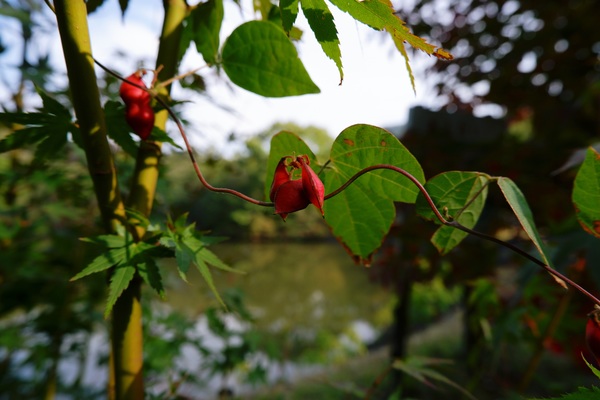
Japanese name: タンキリマメ(痰切豆) Scientific name:Rhynchosia volubilis
[Overview]
A climbing herb found in sunny grasslands and at woodland edges.
The vines extend more than 2 m.
The stems bear short, downward-pointing, yellowish-brown soft hairs.
The leaves are alternate and composed of 3 leaflets; the terminal leaflet is obovate, 3–6 cm long and 2–5 cm wide, with a tip that is not very pointed.
The leaves are somewhat thick, with brown glandular dots on both surfaces and dense short soft hairs on the underside.
The inflorescence is shorter than the leaves, 2–4 cm long, bearing 5–20 flowers in a cluster.
The flowers are yellow and pea-shaped.
The calyx has short soft hairs and glandular dots and is 5-lobed, with the lower 3 lobes longer than the calyx tube.
The fruit is a legume about 1.3 cm long, which turns red when ripe and contains 2 black seeds.
[Uses]
The seeds, stems and leaves are used medicinally.
[Notes]
It can be distinguished from Tokiri-mame by its generally sparse hairs, thinner leaves with sharply pointed tips, and calyx lobes shorter than the calyx tube.