
Plant Encyclopedia

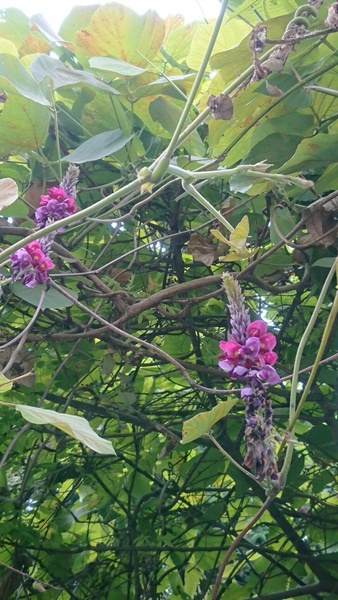
Pueraria lobata subsp. lobata (kudzu)
Japanese name: クズ (葛)
Scientific name: Pueraria lobata subsp. lobata
[Overview]
A climbing perennial found in wasteland and along roadsides.
It stores large amounts of starch underground and has tuberous roots that can reach 1.5 m in length and 20 cm in diameter.
The stems reach 10 m in length, have long brown bristles and white hairs, and become woody at the base.
The leaves are alternate and trifoliate; the leaflets have brown hairs on the upper surface and dense white hairs on the underside.
The terminal leaflet is 10–15 cm in both length and width and is often 3-lobed, while the lateral leaflets are often 2-lobed.
The petiole is long.
Pseudoracemes 20 cm long arise from the leaf axils and bear many reddish-purple pea-type flowers.
The fruit is a flat pod 6–8 cm long and 0.8–1 cm wide, densely covered with long brown bristles.
[History]
It has long been loved as one of the Seven Herbs of Autumn.
It is the personal emblem (oshirushi) of Princess Ayako of Takamado, of the Imperial family.
[Uses]
Starch is extracted from the tuberous roots and made into kuzu powder; as a crude drug it is called kakkon and is used in cold remedies and the like.
The flowers are also used medicinally.
The leaves were once valued as fodder.
The vines are used as a raw material for kuzu cloth and as craft material.
[Cultivation]
Propagate from seed, by division, or by cuttings.
It is easy to grow, and needs management such as cutting back so that it does not spread too much.
[Notes]
It has strong reproductive power and grows thickly, covering other plants; it has been chosen as one of the World's 100 Worst Invasive Alien Species.
It has become naturalized mainly in North America.
Details
Japanese: クズ(葛)、フシゲクズ
Translated from our Japanese encyclopedia. If anything differs, the Japanese page is correct.