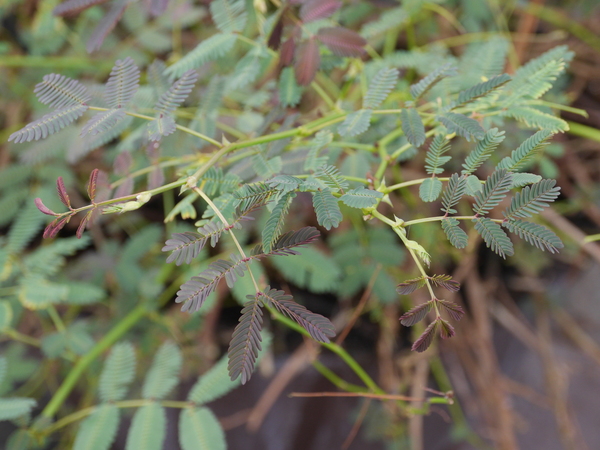
Japanese name: ミズオジギソウ(水含羞草) Scientific name:Neptunia oleracea
[Overview]
A perennial growing in wet, watery places.
The stem does not stand upright but creeps and extends sideways; it is spongy and serves as a float.
The leaves are alternate and bipinnate with small leaflets, and the leaves and petioles are tinged with red.
The leaflets close when the leaf is touched.
Flower heads arise from the leaf axils and bear many 5-petaled flowers.
What stands out in the inflorescence are the yellow, petal-like staminodes of the imperfect flowers.
The fruit is a pod 2–3 cm long containing 4–10 flat seeds.
[Uses]
In Southeast Asia the young stems are used as a vegetable.
[Cultivation]
Propagate from seed or by cuttings.
Grow it in a sunny place, using fertile field soil as the potting soil.
It is sensitive to cold, so bring it indoors in winter.