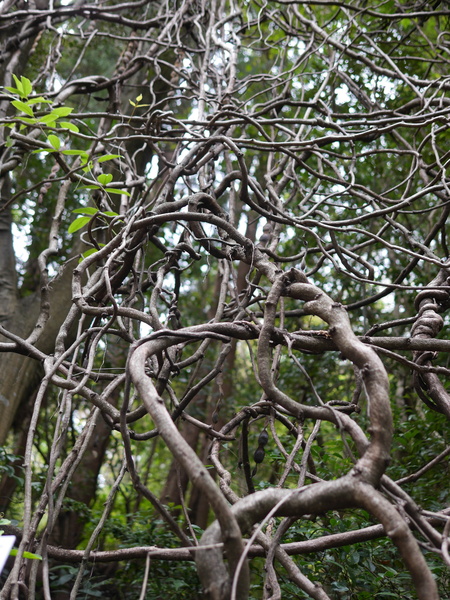
Japanese name: トビカズラ(飛葛) Scientific name:Mucuna sempervirens
[Overview]
A large evergreen woody climber reaching up to 25 m, with a trunk diameter of 30 cm or more.
Young branches have appressed yellow hairs.
The leaves are alternate and trifoliate, 20–40 cm long.
The leaflets are elliptic with pointed tips and glossy on the upper surface, and the reticulate veins are conspicuous on both sides.
The terminal leaflet is 7–15 cm long and 3.5–9 cm wide.
The leaves are at first covered with white hairs and later become hairless.
The petiole is 7–16.5 cm long.
Pseudoracemes 10–36 cm long hang down from the nodes of the trunk and thick branches, bearing 3–20 flowers.
The flowers are dark purple pea-type flowers 7–8.5 cm long.
The fruit is a flat pod 40–60 cm long and 3.5–4 cm wide, densely covered with yellowish-brown hairs.
Each pod holds 7–10 seeds.
[History]
The plants in Japan are thought to have been introduced from China and become naturalized.
The plant in the Sagara district of Kumamoto is designated a Special Natural Monument of Japan as the "Sagara no Aira-tobikazura."
In recent years it has also been found in Amakusa, Kumamoto, and on Tokei-jima off Sasebo, Nagasaki.
[Uses]
The stems, leaves and roots are used medicinally, and the plant is also used for papermaking and to obtain starch and oil.