
Plant Encyclopedia

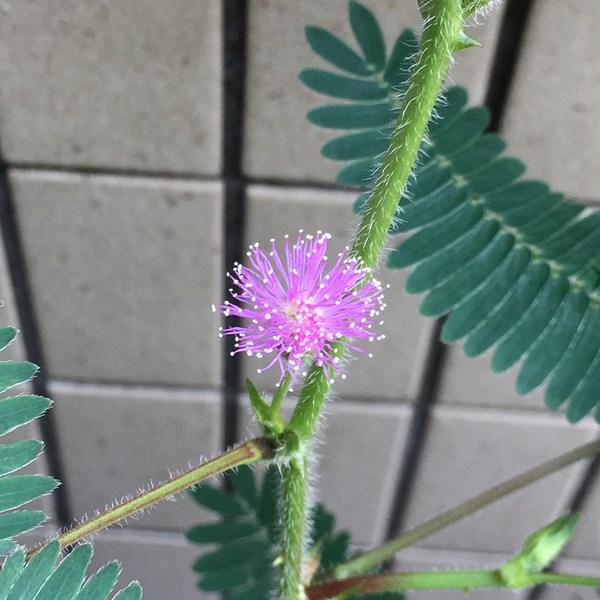
Mimosa pudica (sensitive plant, "Ojigiso")
Japanese name: オジギソウ (お辞儀草)
Scientific name: Mimosa pudica
[Overview]
A perennial 30–50 cm tall, but because it is sensitive to cold it is treated as an annual.
The stems branch freely and have brown hairs and sharp spines.
The leaves are alternate and bipinnate with an even number of leaflets, bearing 1–2 pairs of nearly opposite pinnae 3–8 cm long.
Each pinna bears 10–20 pairs of narrowly elliptic to linear-lanceolate leaflets, about 6–15 mm long and 1.5–3 mm wide.
The leaves close and droop when touched by hand or when it gets dark.
Flower heads about 1 cm across bear pink flowers.
The long stamens stand out in a brush-like shape.
The fruit is a flat, jointed pod 1–2 cm long and 0.5 cm wide, with bristles and spines on the margin.
When ripe it breaks apart at the joints and falls.
[History]
It is said to have been introduced as an ornamental plant in the Edo period (Tenpo 12, 1841).
[Uses]
The whole plant is used medicinally.
[Cultivation]
Propagate from seed.
The seed coat is hard, so nick the seeds before sowing, or soak them in 60 °C water for 30 minutes, leave them in the water for half a day to 2 days, and then sow.
The optimum germination temperature is 25 °C or higher.
It prefers a sunny, well-drained location.
Water thoroughly when the soil surface dries.
Fertilizer is not particularly necessary.
There are no particular pests or diseases.
[Notes]
The Japanese name comes from the way the leaves fold.
Details
Japanese: オジギソウ(お辞儀草)、ネムリグサ(眠り草)、ミモザ
Translated from our Japanese encyclopedia. If anything differs, the Japanese page is correct.