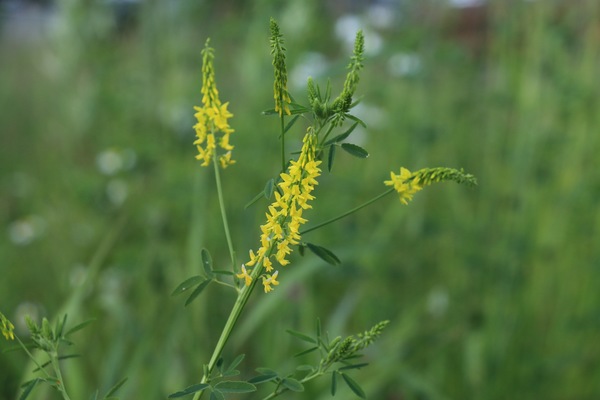
Japanese name: シナガワハギ(品川萩) Scientific name:Melilotus officinalis subsp. suaveolens
[Overview]
A winter annual 20–150 cm tall, found on seashores, along roadsides, and on vacant lots.
It has a scent of coumarin.
The stem is erect and branches often.
The leaves are odd-pinnately compound with 3 leaflets; the leaflets are narrowly oblong, 1.5–3 cm long, with toothed margins.
The stipules are needle-like, 0.2–0.5 cm long, and fused to the leaf stalk.
Racemes arise from the leaf axils, 2–15 cm long including the flower stalk.
The flowers are yellow pea-shaped flowers, 0.4–0.6 cm long.
The fruit is a broadly elliptic pod about 0.2–0.3 cm long, with an indistinct, irregular net-like roughness on the surface.
Each fruit contains 1 seed.
[Uses]
The whole plant has been used medicinally, and the dried flower spikes are used to flavor tobacco and beer.
It is used as fodder.
It is a nectar source plant.
[Notes]
The name comes from its having been found near Shinagawa in Tokyo.