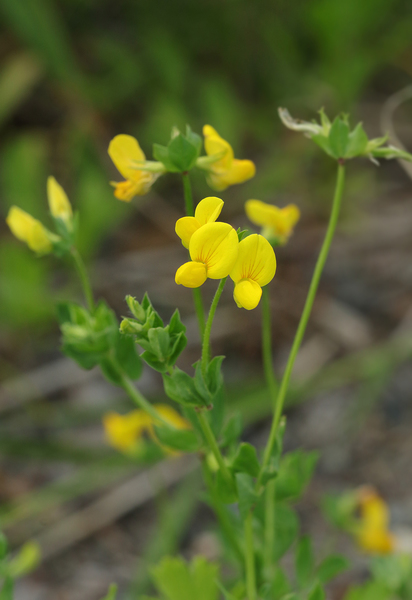
Japanese name: ミヤコグサ(都草) Scientific name:Lotus corniculatus var. japonicus
[Overview]
A perennial commonly seen along roadsides, on seashores and on embankments.
The stems are 5–40 cm long, branch freely from the base, and creep along the ground, with the stem tips rising obliquely.
Leaves are borne alternately at each node of the stem.
The leaves are odd-pinnately compound with 5 leaflets, but because the basal pair is small and stipule-like, they look like trifoliate leaves.
The leaflets are obovate and thick, a whitish green as if dusted with powder.
At the tip of the flower stalk, 1–3 flowers are borne in an umbel-like cluster, and at the base of the flowers there are bracts of almost the same shape as the leaves, divided into three.
The flowers are bright yellow and pea-shaped.
The fruit is a slender cylindrical pod 2–3.5 cm long; when ripe it twists and splits into 2 pieces, releasing about 20 seeds.
[Cultivation]
Propagate from seed.
It grows easily in a sunny, well-drained place.