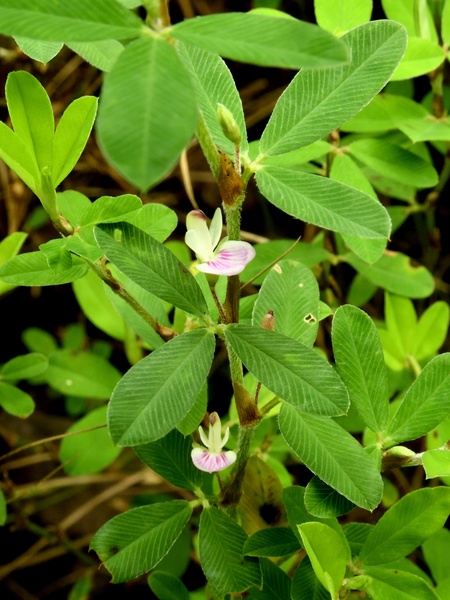
Japanese name: ヤハズソウ(矢筈草) Scientific name:Kummerowia striata
[Overview]
An annual found on sunny roadsides, riverbeds and similar places.
The stem has many downward-pointing hairs, and either creeps along the ground or rises obliquely to a height of 15–40 cm.
Leaves are alternate and trifoliate; the terminal leaflet is oblong, 1–1.5 cm long, and the leaf tip is not notched.
The midrib and margin of the leaf have appressed white hairs.
The lateral veins are parallel and reach the leaf margin, and the margin is entire.
The stipules are broadly ovate, brown, membranous, and clasp the stem.
The flowers are pea-shaped, 0.5 cm long, borne singly or several together in the leaf axils; the standard is pale reddish purple with reddish purple lines, the wings and keel are white, and the tip of the keel is dark brown.
The calyx is 5-lobed and has appressed hairs.
The fruit is a flat jointed pod, slightly longer than the calyx, pointed at the tip, with appressed short hairs.
Each fruit contains one seed.
[Notes]
The Japanese name comes from the fact that, because the parallel lateral veins reach the leaf margin, pinching the tip of a leaflet and pulling it cuts it off in the shape of an arrow notch (yahazu).