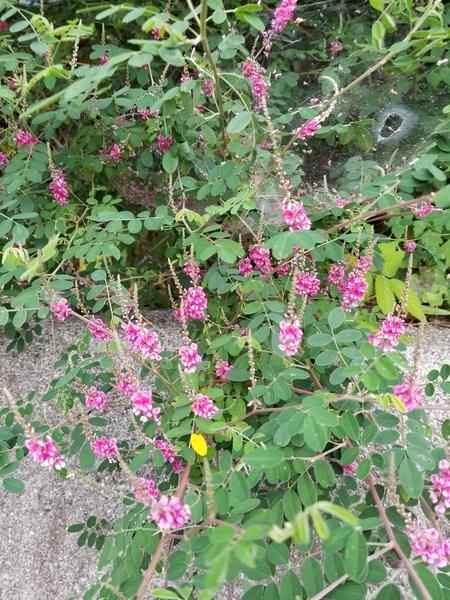
Japanese name: コマツナギ(駒繋) Scientific name:Indigofera pseudotinctoria
[Overview]
A deciduous shrub 40–100 cm tall, found in sunny, dry places such as riverbeds.
The stems and leaves have white hairs branching in a T shape.
The leaves are alternate and odd-pinnately compound, consisting of 5–11 leaflets.
The leaflets are elliptic, 0.5–2.5 cm long and 0.3–1.5 cm wide.
Racemes 4–10 cm long emerge from the leaf axils, bearing fairly dense, pale pink pea-shaped flowers 0.4–0.6 cm long.
The fruit is a cylindrical legume 2–2.5 cm long.
[Uses]
The roots are used medicinally.
[Cultivation]
Propagate by cuttings or division.
It prefers a sunny, well-drained site.
For potted plants, water thoroughly when the soil surface dries; for plants in the ground, rainfall is sufficient.
Fertilizer is not particularly necessary.
There are no particular pests or diseases.
[Notes]
The Japanese name is said to come from the stems being strong enough to tether a horse.
Some views treat it as the same species as To-komatsunagi.