
Plant Encyclopedia

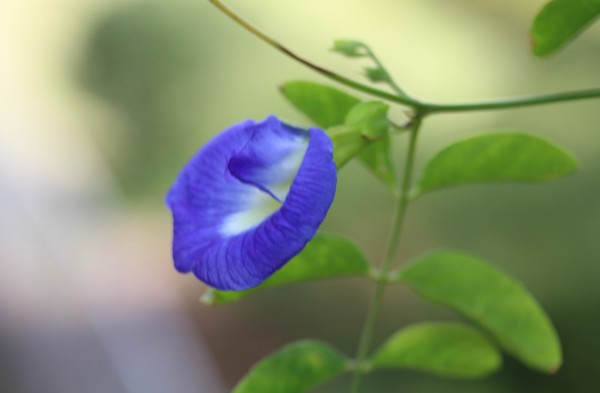
Clitoria ternatea (Asian pigeonwings, "Chomame")
Japanese name: チョウマメ (蝶豆)
Scientific name: Clitoria ternatea
[Overview]
A climbing perennial, but treated as an annual in Japan.
The stems are covered with soft hairs.
Leaves are alternate and odd-pinnately compound, consisting of 5–9 leaflets.
The leaflets are elliptical with entire margins.
Stipules are present.
The flowers are pea-shaped, borne singly in the leaf axils, and a vivid blue with the center fading to pale yellow.
The standard petal is large and well developed, but because the flower is inverted, the standard petal is positioned at the bottom.
There are garden cultivars with double flowers and different flower colors.
The fruit is a flat legume about 10 cm long containing blackish-brown seeds.
[History]
It was introduced to Japan in the Edo period.
[Uses]
The flowers are used as a food coloring and for herbal tea, and the immature pods are edible.
The leaves and roots are used medicinally.
[Cultivation]
Propagate from seed.
It is sensitive to cold, so treat it as an annual.
It prefers sunny, well-drained soil.
It dislikes transplanting, so sow directly, or sow in pots and plant out while the seedlings are still young.
For potted plants, water thoroughly when the soil surface dries; for plants in the ground, rainfall is sufficient.
If base fertilizer is applied, no further fertilizing is particularly needed.
There are no particular pests or diseases.
Details
Japanese: チョウマメ(蝶豆)、バタフライピー
Translated from our Japanese encyclopedia. If anything differs, the Japanese page is correct.