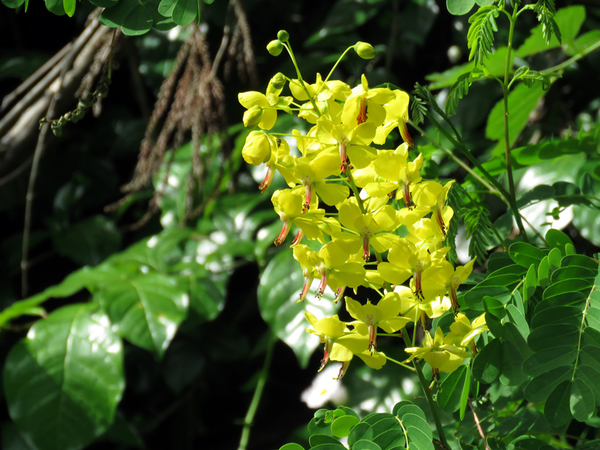
Caesalpinia decapetala var. japonica("Jaketsuibara")
Japanese name: ジャケツイバラ(蛇結茨) Scientific name:Caesalpinia decapetala var. japonica
[Overview]
A deciduous shrub 2–3 m tall, or a deciduous woody vine growing up to 10 m long, found on riverbeds and in fields.
The branches grow long and have downward-pointing thorns.
The leaves are alternate and bipinnately even-pinnate, consisting of 6–16 pinnae, each with 5–12 pairs of leaflets.
The leaflets are 1–2.5 cm long and 0.5–1 cm wide, with rounded tips and undersides tinged with white.
The leaf axis and petiole have downward-pointing thorns.
A pseudoraceme 20–30 cm long emerges at the branch tips, bearing yellow five-petaled flowers 2.5–3 cm across.
Of the petals, the upper one is slightly smaller and has a red pattern.
The stamens are red.
The fruit is a legume, flat and oblong, 7–10 cm long and 3 cm wide.
The legume has no thorns or hairs.
The seeds are elliptic, 1 cm long, and blackish brown.
[Uses]
The seeds are poisonous but are used medicinally.
[Cultivation]
Propagate from seed or cuttings.
It grows well in any soil as long as the site is sunny and well drained.
With poor sunlight, flowering is poor.
Rainfall is sufficient for watering.
Fertilizer is not particularly necessary.
There are no particular pests or diseases.
[Notes]
The name is said to compare the way the branches tangle and grow thickly to a coiled snake.