
Plant Encyclopedia

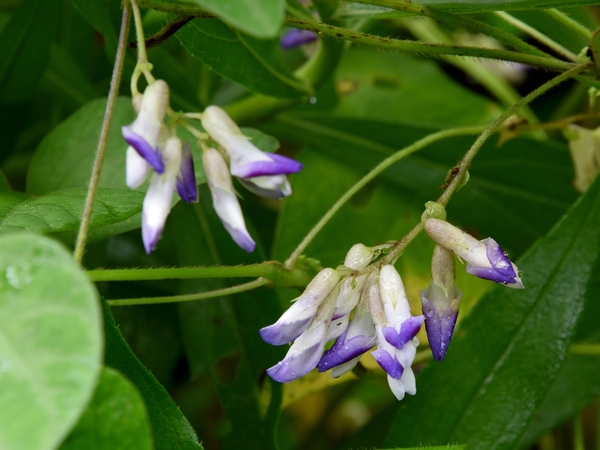
Amphicarpaea bracteata subsp. edgeworthii ("Yabumame")
Japanese name: ヤブマメ (藪豆)
Scientific name: Amphicarpaea bracteata subsp. edgeworthii
[Overview]
A climbing annual found along roadsides and woodland edges.
The vine twines to the right and grows to about 2 m.
It has underground stems.
The stems, petioles and inflorescence axes bear white to yellowish-brown hairs.
The leaves are alternate and composed of 3 pinnate leaflets; the terminal leaflet is ovate, 3–9 cm long and 2–6 cm wide, with short white appressed hairs on both surfaces.
The petiole is 1–5.5 cm long.
There are small ovate stipules.
The flowers are of two kinds, open flowers and closed flowers, and closed flowers are also borne underground.
The open flowers are borne 5–12 in pseudoracemes 1–6 cm long arising from the leaf axils; they are white, with the tip of the standard petal pale purple.
The closed flowers are borne separately from the open flowers and are entirely enclosed by the calyx.
The underground closed flowers are of two kinds: those borne at the tips of the underground stems, and those borne at the tips of branches that extend into the soil from leaf axils near the ground surface.
The fruit is a legume; those formed from the open and closed flowers above ground are narrowly oblong, 2.5–3 cm long and 0.6–0.8 cm wide, densely hairy on the margins, and contain 2–4 seeds (beans).
The beans of the aboveground fruits are dark brown with black spots.
The fruits formed underground are round, enclosed in a thin pale brown pericarp, and usually contain 1 seed (bean).
The beans of the underground fruits are larger than the aboveground ones, pale in color, with reddish-purple spots.
[Uses]
The beans formed underground are edible.
Details
Translated from our Japanese encyclopedia. If anything differs, the Japanese page is correct.