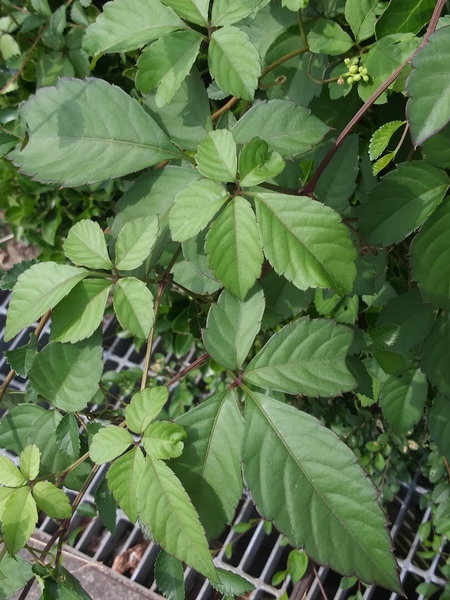
Japanese name: ヤブカラシ(薮枯) Scientific name:Cayratia japonica
[Overview]
A climbing perennial commonly seen along roadsides, in vacant lots and in fields.
It spreads by sending out long underground stems.
The stem is ridged.
Opposite the leaves and inflorescences it produces tendrils with forked tips, which twine around other plants and objects.
The leaves are alternate and compound, made up of 5–7 leaflets arranged like a bird's foot.
The leaflets are narrowly ovate with pointed tips and wavy serrations.
The terminal leaflet is 4–8 cm long.
Flat cymes bear many green four-petaled flowers about 5 mm across.
The petals fall easily, and the red to orange disc is conspicuous.
The flowers produce abundant nectar, which attracts butterflies such as Aosuji-ageha.
The fruit is a fleshy berry that ripens black, but individuals that bear fruit are common in western Japan and rare in eastern Japan.
[Notes]
The Japanese name comes from the plant's growth, which is so vigorous that it kills the thickets it covers.
There are several theories about the other name, Binbo-kazura: that it grows in neglected gardens too poor to be tended, that the place looks shabby when this plant thrives, and that it kills fields and forests and makes people poor.