
Plant Encyclopedia

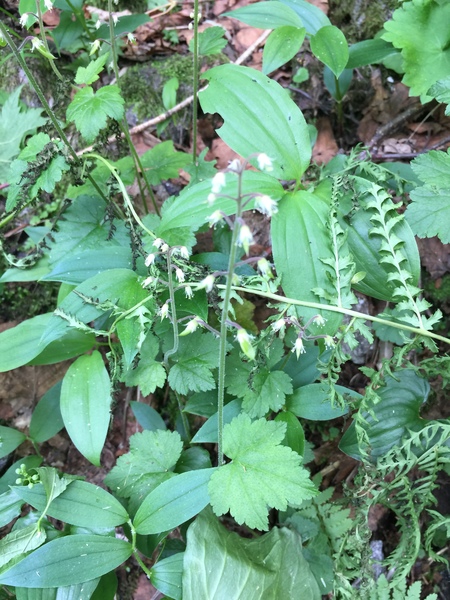
Tiarella polyphylla ("Zudayakushu")
Japanese name: ズダヤクシュ (喘息薬種)
Scientific name: Tiarella polyphylla
[Overview]
A perennial 10–40 cm tall, found in beech forests and in coniferous forests of the subalpine zone.
It has a slightly creeping rhizome.
The leaves are of two kinds, basal leaves and stem leaves; the basal leaves have petioles 2–12 cm long and are densely covered with glandular hairs.
The leaves on the stem are alternate and have short petioles.
Both basal and stem leaves are cordate-orbicular to broadly ovate, shallowly 5-lobed, with palmate veins.
Hairs grow on the upper surface of the leaf and on the veins of the underside.
The leaf margins are serrated.
A raceme bears several to 25 flowers.
The flower stalks have glandular hairs.
The flowers are white with 5 needle-like petals.
What looks like a white, bell-shaped corolla is actually the calyx.
There are 10 stamens, which project far out of the flower.
The fruit is a capsule with 2 carpels of different lengths; when the longer, lower carpel receives a water drop, it flings out the seeds inside.
[Uses]
It has been used as a folk remedy to relieve coughs.
[Cultivation]
Propagate from seed.
It prefers fertile, well-drained soil in partial shade to shade.
When planted in the ground, it is best placed under deciduous trees.
For potted plants, water thoroughly when the soil surface dries; for plants in the ground, rainfall is sufficient unless summer brings a long spell of sunny weather and the soil becomes severely dry.
Apply slow-release fertilizer placed on the soil in spring and autumn.
There are no particular pests or diseases.
[Notes]
The Japanese name comes from "Zuda", said to be a dialect word of the Kiso region of Nagano meaning asthma; the plant was given this name because it was used to relieve coughs.
Details
Translated from our Japanese encyclopedia. If anything differs, the Japanese page is correct.