
Plant Encyclopedia

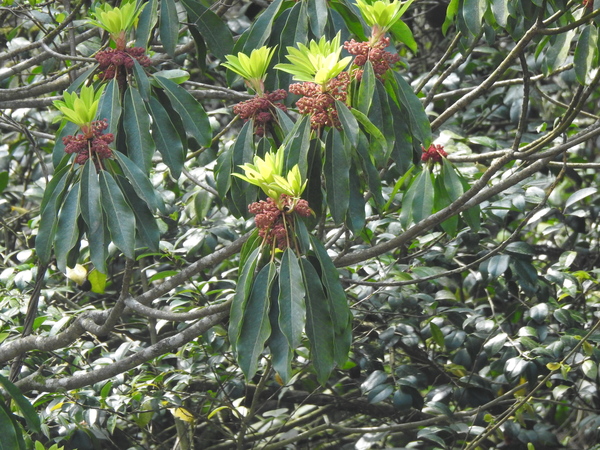
Daphniphyllum macropodum subsp. macropodum ("Yuzuriha")
Japanese name: ユズリハ (譲葉)
Scientific name: Daphniphyllum macropodum subsp. macropodum
[Overview]
An evergreen tree over 10 m tall, found in mountain evergreen broadleaf forests.
It branches well.
The leaves are simple and alternate, gathered in whorl-like clusters at the branch tips.
They are oblong, 15–20 cm long and 4–6 cm wide, glossy on the upper surface and tinged powdery white on the underside.
There are 16–19 pairs of lateral veins.
The leaf margin is entire.
The petiole is 4–6 cm long and reddish.
It is usually dioecious.
Both male and female plants produce racemes 4–12 cm long in the leaf axils, bearing many small flowers.
Both male and female flowers lack petals; male flowers have no sepals, or 1–2 very small ones.
The male flowers have 6–12 stamens.
In the female flowers, the base of the ovary is enclosed by very small sepals, and there are 2–4 styles with tips that curve back.
The fruit is an ovoid drupe 0.6–1 cm long, ripening blackish blue and covered with a white bloom.
[Uses]
Although poisonous, the bark and leaves are used medicinally.
Because the old leaves fall only after the new leaves have opened, it is regarded as an auspicious tree whose generations continue without end, and the leaves are used in New Year decorations.
[Cultivation]
Propagate from seed.
The germination rate drops if the seeds dry out, so harvest ripe fruit, wash off the pulp, bury the seeds in moistened vermiculite or similar so they do not dry out, store them in a cool, dark place, take them out the following spring, and wash them well once more before sowing.
It prefers fertile soil that is sunny, well drained, moisture-retentive, and moderately moist.
It dislikes dryness, so avoid places that dry out easily, such as those exposed to strong afternoon sun or dry winter cold winds.
It tolerates shade, but becomes leggy if the light is poor.
For plants within 1 year of planting in the ground, water thoroughly when the soil surface dries; for established plants, rainfall is sufficient.
Bury organic fertilizer around the plant in winter.
It may drop its leaves if the soil becomes poor.
It is slow to resprout after pruning, so limit pruning to thinning out obstructive branches.
There are no particular pests or diseases.
[Notes]
The Japanese name comes from the fact that the old leaves fall after the new leaves have opened.
Details
Translated from our Japanese encyclopedia. If anything differs, the Japanese page is correct.