
Plant Encyclopedia

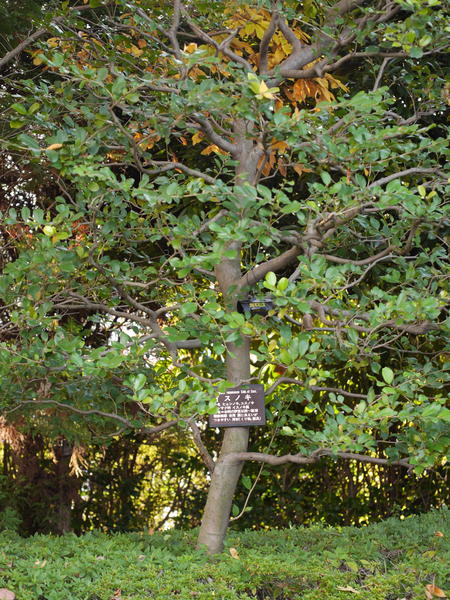
Distylium racemosum ("Isunoki")
Japanese name: イスノキ (柞、柞樹)
Scientific name: Distylium racemosum
[Overview]
An evergreen tree 8–10 m tall, found in forests.
The trunk turns reddish brown as it thickens.
Young branches are at first covered with stellate hairs and tinged with yellow.
Leaves are simple and alternate, obovate, 3–7 cm long and 1.5–3 cm wide, with an entire margin or a few wavy teeth in the upper part.
The upper surface of the leaves is glossy, and the texture is thick and hard.
Large galls often form on the leaves.
The petiole is 5–10 mm long.
Racemes 2.5–4 cm long emerge from the leaf axils, bearing bisexual flowers in the upper part and male flowers in the lower part.
The flowers have no petals, and the red stamens are conspicuous.
The fruit is a broadly ovate capsule 7–10 mm long, densely covered with grayish white hairs on the surface, with the style remaining at the tip.
[Uses]
The wood is extremely hard, is regarded as the heaviest of all Japanese timbers, and is highly durable.
It is used as material for furniture, tools, musical instruments (such as the plectra of the shamisen and biwa) and decorative alcove pillars.
Wooden swords made from this tree are also used in Jigen-ryu (a school of swordsmanship).
Flutes are made for play from the large galls that form on the leaves.
[Cultivation]
Propagate from seed or from cuttings.
It tolerates sea wind, grows well even in poor soil, and is hardy.
[Notes]
The alternative name Hyon-no-ki comes from the sound of the flutes made from the galls.
Details
Translated from our Japanese encyclopedia. If anything differs, the Japanese page is correct.