
Plant Encyclopedia

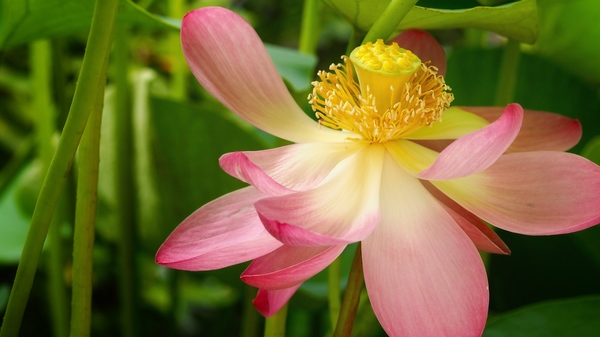
Nelumbo nucifera (sacred lotus, "Hasu")
Japanese name: ハス (蓮)
Scientific name: Nelumbo nucifera
[Overview]
A large aquatic perennial.
The underground stem extends through the soil at the bottom of the water, forming nodes, and each node bears a leaf bud and a flower bud.
The leaves that appear in spring are floating leaves that lie on the water surface.
In summer, leaves with long petioles are produced above the water, and in autumn somewhat smaller leaves called tomeba (final leaves) are produced.
When the final leaves appear, the underground stems in the soil begin to swell.
The leaves are simple, elliptic to circular, with entire margins that are slightly wavy. The leaf surface is waxy and repels water.
Veins radiate from the center of the leaf.
The petiole is strong and long, sometimes exceeding 1.5 m, and has prickle-like projections.
The flower is borne singly at the tip of a flower stalk longer than the petiole.
The petals are obovate, usually 20–25 in number, and pink-red. There are 200–400 stamens.
The receptacle is honeycomb-like with a flat upper surface and has many holes; a pistil lies in each hole, and seeds form there.
[History]
Centered on China and India, it has been connected with culture and religion since ancient times.
It has also been cultivated in Japan since ancient times.
[Uses]
There are strains grown for food and strains grown for their flowers.
In the edible strains, the swollen underground stem is used as renkon (lotus root).
The young stems are edible, and cloth can be woven from the fibers of the stems.
The leaves are used in dishes such as lotus-leaf rice.
The flowers are made into flower tea.
The seeds are used as food and medicine.
[Cultivation]
Propagate from seed or by root division.
It prefers fertile, clayey soil in a sunny location. Paddy soil is suitable, but akadama soil mixed with 10–20% leaf mold is also fine.
Always keep it in a state with water standing. To prevent mosquito larvae, medaka (small freshwater fish) may be kept together with it.
In addition to base fertilizer, apply slow-release fertilizer once a month from spring to autumn.
For root division, cut off 2–3 nodes of underground stem bearing new shoots and plant them horizontally.
When digging up the underground stems, take care not to damage the new shoots or the underground stems, and not to let them dry out.
Because the seed coat of the seeds is hard, make a nick in it, soak the seeds in water, and plant those that have germinated.
Pests and diseases include rot, brown spot, leaf spot, shirashibu disease and aphids.
Remove dead leaves, as they cause disease.
Details
Japanese: ハス(蓮)、ハチス
Translated from our Japanese encyclopedia. If anything differs, the Japanese page is correct.