
Plant Encyclopedia

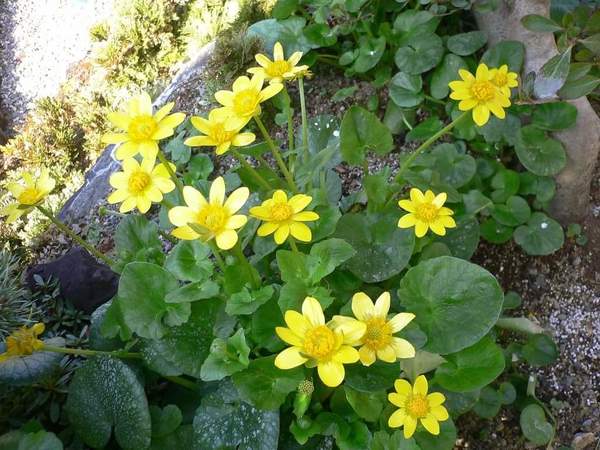
Ficaria verna (lesser celandine, "Kikuzakiryukinka")
Japanese name: キクザキリュウキンカ (菊咲立金花)
Scientific name: Ficaria verna
[Overview]
A perennial about 30 cm tall, found in its native habitat in damp meadows in the mountains and at the edges of lakes and marshes.
It is a winter-green plant whose aboveground parts die back by the end of May; it is dormant in summer and sprouts again in autumn.
It has tuberous roots underground and produces short stems that branch freely at the base.
The leaves are simple, alternate in a spiral, and heart-shaped to triangular.
The leaf surface is glossy.
The petiole is long and widens at the base.
Flower stalks extend from the leaf axils, each bearing a single yellow flower about 3 cm across.
The flowers have no petals; 7–12 glossy sepals stand out like petals.
The fruit is an achene, gathered into a shape like a konpeito (star-shaped sugar candy).
[Uses]
It is poisonous, but is used medicinally.
[Cultivation]
Propagate from seed or by division.
Sow seed immediately after harvesting.
As long as the site is sunny and well drained, it is not particular about soil, but it seems to be somewhat poorer in acidic soil.
It is hardy and easy to grow.
It is also very cold tolerant, but the leaves may be damaged by cold wind or frost.
In the ground, if the conditions suit it, it spreads and other plants lose out, so caution is needed.
For potted plants, water once a day during the autumn–spring growing season; for plants in the ground, rainfall is sufficient.
During dormancy, water only enough to keep the soil from drying out.
It tolerates some dryness while dormant, but take care not to let it run short of water during the growing period.
Fertilizer is not particularly necessary.
Pests and diseases include gray mold, viral diseases and aphids.
[Notes]
The Japanese name comes from its resemblance to Ryukinka, but it is a plant of a different genus.
Details
Japanese: キクザキリュウキンカ(菊咲立金花)、ヒメリュウキンカ(姫立金花)
Translated from our Japanese encyclopedia. If anything differs, the Japanese page is correct.