
Plant Encyclopedia

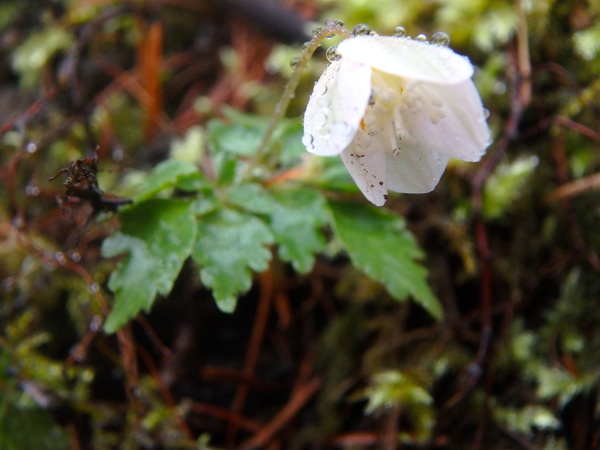
Dichocarpum hakonense
Japanese name: ハコネシロカネソウ (箱根白銀草)
Scientific name: Dichocarpum hakonense
[Overview]
A perennial 5–20 cm tall, found in deciduous forests in the mountains.
The whole plant is hairless and soft.
It has a thick, short rhizome. It usually produces no stolons, and if it does they are short.
The leaves are of two kinds, basal leaves and leaves opposite on the stem. Both are pedately compound with coarsely toothed margins.
1–4 basal leaves are produced. The terminal leaflet is broadly rhombic-ovate to broadly ovate, 0.4–1.5 cm long and 0.5–1.5 cm wide, and the petiole is 2–5 cm long.
Two stem leaves are produced. The terminal leaflet is broadly rhombic-ovate to broadly ovate, 0.5–1.7 cm in both length and width, and the bases of the petioles are partly fused.
At the tip of a flower stalk 1–2.5 cm long, 1–3 flowers 0.6–1 cm across are borne singly or in a cyme, facing upward and almost fully open.
Two leaf-like bracts are borne opposite on the flower stalk; the bracts are deeply 3-lobed or divided into 5 leaflet-like parts, with their bases fused.
The 5 petal-like white sepals are conspicuous in the flower.
The petals are spoon-shaped orange nectaries.
Cleistogamous flowers are usually not produced.
The fruit is a follicle, borne in pairs.
The seeds are spherical, 0.1 cm in diameter, with a smooth, glossy surface.
Details
Translated from our Japanese encyclopedia. If anything differs, the Japanese page is correct.