
Plant Encyclopedia

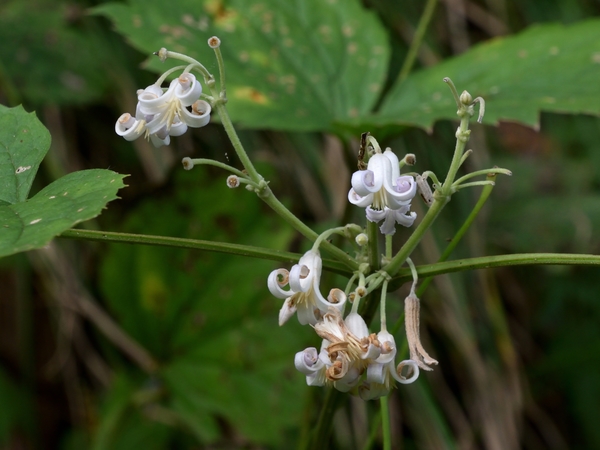
Clematis stans var. stans ("Kusabotan")
Japanese name: クサボタン (草牡丹)
Scientific name: Clematis stans var. stans
[Overview]
A deciduous shrub 0.5–1 m tall, found at forest edges and in grasslands in the mountains.
The stems are pale purplish brown and erect.
The leaves are opposite and once ternately compound.
The leaflets are broadly ovate, 5–14 cm long and 3–11 cm wide, shallowly 3-lobed, with coarse serrations on the margins.
The leaf surface is not glossy, and the veins are sunken.
The leaf stalk is 4–20 cm long.
Compound cymes arise at the tips and leaf axils of the current year's branches, bearing many downward-facing flowers.
The flowers are either male or female, pale bluish purple, with 4 conspicuous petal-like sepals.
The sepals are strongly recurved.
The flower stalk is 0.3–1 cm long.
The fruit is an achene 2–3.5 mm long.
The long style of the pistil remains on the fruit and becomes feathery with dense hairs.
[Uses]
It is poisonous, but the whole plant is used medicinally.
[Cultivation]
Propagate by cuttings.
Take cuttings from new vines that grew after flowering, cutting them when the surface becomes firm.
It prefers a sunny, well-drained, well-ventilated place with fertile soil.
Avoid places where strong afternoon sun hits the base of the plant, and dry places.
It is also somewhat sensitive to the heat and humidity of midsummer, so move potted plants to a cool, airy place in partial shade.
It dislikes dryness, so take care not to let it dry out too much, and water thoroughly when the soil surface dries.
Place organic fertilizer on the soil after flowering and in autumn.
The vines grow vigorously, so train them onto a support or similar.
Flower buds form on the new shoots, and heavy pruning after autumn will prevent flowering the following year, so avoid pruning as much as possible or limit it to light pruning that tidies the branch tips.
There are no particular pests or diseases.
Details
Translated from our Japanese encyclopedia. If anything differs, the Japanese page is correct.