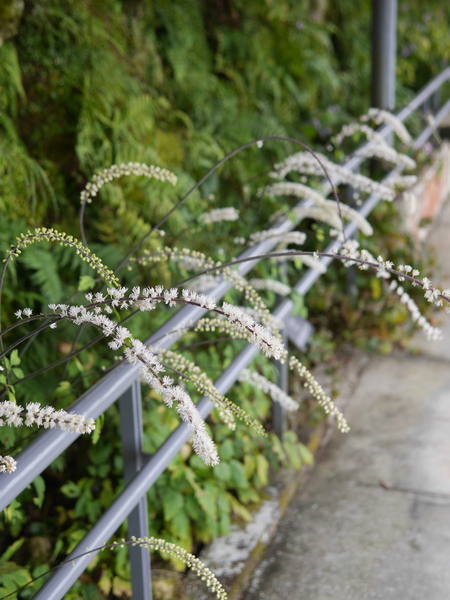
Japanese name: サラシナショウマ(晒菜升麻) Scientific name:Cimicifuga simplex
[Overview]
A perennial 50–150 cm tall, found in deciduous broadleaf forests, at forest edges and in grasslands in the mountains.
It has a thick rhizome.
One stem is produced from the rhizome each year, with white hairs on the upper part of the stem.
There are basal leaves and stem leaves arranged alternately on the stem.
The basal leaves and the lower leaves of the stem are large and 3 times ternately compound.
The leaflets are ovate, 3–8 cm long, often 3-lobed, with irregular, incised teeth on the margin.
Both sides of the leaves have fine hairs.
The upper leaves of the stem are 2–3 times ternately compound.
A long, cylindrical raceme is produced, densely covered with short white hairs.
The flowers are small and white, with petal-like sepals and petals that fall soon after the flower opens, so the many white stamens stand out.
As a result, the inflorescence looks like a brush.
The flowers have stalks.
The fruit is a follicle about 1 cm long.
[Uses]
The young shoots are eaten as a wild vegetable, and the rhizome is used as a crude drug called shoma (升麻).
[Notes]
The Japanese name Sarashina (晒菜) comes from the practice of boiling the young shoots and soaking them in water.