
Plant Encyclopedia

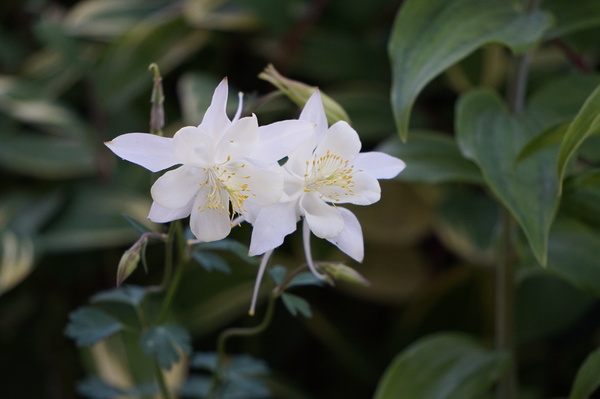
Aquilegia flabellata var. flabellata ("Odamaki")
Japanese name: オダマキ (苧環)
Scientific name: Aquilegia flabellata var. flabellata
[Overview]
A perennial 30–50 cm tall, cultivated as an ornamental in Japan since ancient times.
It has a thick, sturdy rhizome.
The stem branches in the upper part.
There are two kinds of leaves: basal leaves and stem leaves.
The basal leaves are twice-ternately compound, and 3–10 appear.
The leaflets are ovate-rhombic and 3-lobed, with large rounded serrations on the edges.
The basal leaves have petioles.
One or two stem leaves are borne alternately, and are once-ternately compound.
The leaves are tinged with powdery white.
A raceme at the tip of the stem bears 1–3 flowers hanging downward.
The flowers have a distinctive shape: 5 petal-like sepals spread open, and the petals gather in the center in a tube.
The lower half of each petal forms a slender, pouch-like spur that extends long behind the flower from between the sepals.
Nectar collects inside the spur.
The fruit is a follicle.
[History]
It is thought to be an improved form of Miyama-odamaki.
[Cultivation]
Propagate from seed or by division.
For division, separate by hand the parts where the rhizome has naturally split.
It prefers a sunny, well-drained place.
It may weaken in the direct sunlight of midsummer, so in summer it is good to move potted plants to bright shade with good air circulation, and to plant those in the ground where they will be in the shade of deciduous trees.
For potted plants, water thoroughly when the soil surface dries; for plants in the ground, rainfall is sufficient unless sunny weather continues and the soil becomes severely dry.
If base fertilizer is applied, almost no further fertilizer is needed, but for potted plants liquid fertilizer may be given once every 2 weeks during flowering.
Pests and diseases include soft rot, powdery mildew, aphids, spider mites, cutworms and slugs.
[Notes]
The Japanese name compares the shape of the flower to an odamaki (a spool wound with spun hemp thread).
Details
Translated from our Japanese encyclopedia. If anything differs, the Japanese page is correct.