
Plant Encyclopedia

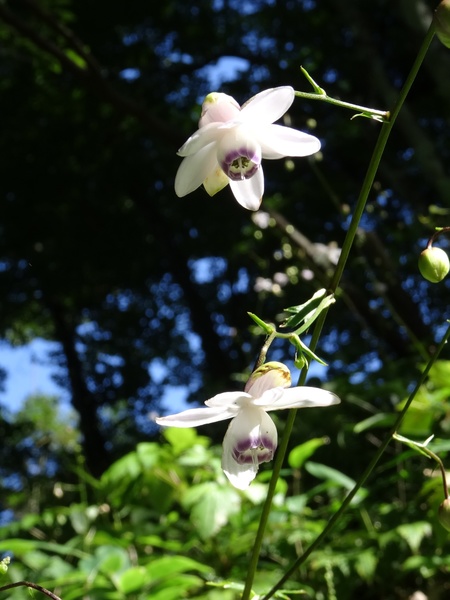
Anemonopsis macrophylla ("Rengeshoma")
Japanese name: レンゲショウマ (蓮華升麻)
Scientific name: Anemonopsis macrophylla
[Overview]
A perennial 40–100 cm tall, found in deciduous forests.
It has a rhizome.
The stem branches sparsely in the upper part.
There are basal leaves and stem leaves; the basal leaf is 2–4 times ternately compound, 15–30 cm long and 30–40 cm wide, and only one appears, remaining even at flowering time.
The leaflets are ovate, 7–10 cm long and 6–10 cm wide, sometimes 3-lobed, with coarse serrations on the edges.
The basal leaf has a petiole 10–20 cm long, and the base of the petiole clasps the stem like a sheath.
One or two stem leaves are borne alternately; they are 1–20 cm in both length and width, 1–3 times ternately compound, and have petioles.
A raceme at the tip of the stem bears 3–7 pale purple flowers 3–4 cm across, which hang downward.
The flowers have a distinctive shape: 7–10 petal-like sepals spread open, and 10–13 petals gather in the center in a tube.
The tips of the petals are deep purple.
The fruit is a follicle.
[Cultivation]
Propagate from seed or by division.
It prefers partial shade and a well-drained place with moderate moisture.
In strong sunlight the leaves and flower buds are damaged and the plant weakens.
For potted plants, place them in bright shade with good air circulation; for plants in the ground, it is good to plant them where they will be in the shade of deciduous trees.
It dislikes dryness, so water every day during the growing period, but in summer water in the evening or later, when the temperature has fallen.
Do not let it dry out completely even during dormancy.
Apply base fertilizer, and also place slow-release fertilizer on the soil in spring and autumn.
Pests and diseases include soft rot, powdery mildew, aphids, spider mites, cutworms and slugs.
[Notes]
The Japanese name derives from the flowers resembling those of Hasu and the leaves resembling those of Sarashina-shoma.
Details
Translated from our Japanese encyclopedia. If anything differs, the Japanese page is correct.