
Plant Encyclopedia

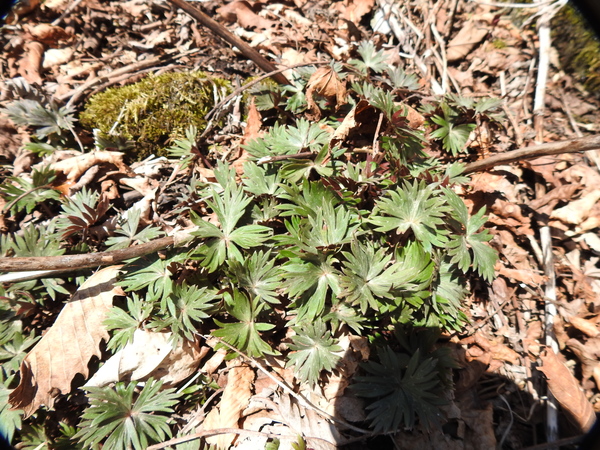
Aconitum japonicum subsp. napiforme ("Tannatorikabuto")
Japanese name: タンナトリカブト (耽羅鳥兜)
Scientific name: Aconitum japonicum subsp. napiforme
[Overview]
The most common monkshood (Aconitum) from the Chugoku region westward.
Found in forests and at forest edges, a pseudo-annual 15–150 cm tall.
There are basal leaves and stem leaves, and the basal leaves and the lower stem leaves have withered by flowering time.
The stem leaves are alternate, 4–14 cm long and 4.5–16 cm wide, pentagonal, and deeply 3-lobed or divided into 3 to the base.
A corymb-like inflorescence about 4.5–9 cm long bears 2–8 blue-purple flowers.
The 5 sepals are petal-like, and the upper one is shaped like a helmet.
The helmet part is mitre-shaped with a long beak, or conical with a short beak.
The petals are inside the helmet and have a slender spur.
The spur is bent through 180 degrees or less.
The stamens are hairless.
The fruit is a follicle, erect.
[Uses]
Although poisonous, the tuberous root is used medicinally.
Details
Translated from our Japanese encyclopedia. If anything differs, the Japanese page is correct.