
Plant Encyclopedia

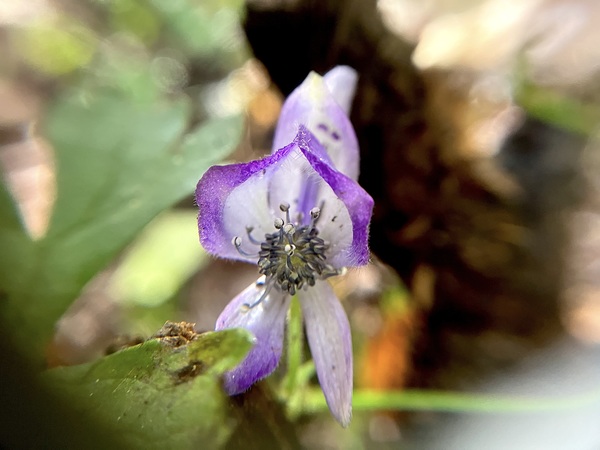
Aconitum japonicum subsp. japonicum ("Yamatorikabuto")
Japanese name: ヤマトリカブト (山鳥兜)
Scientific name: Aconitum japonicum subsp. japonicum
[Overview]
A monkshood (Aconitum) that grows in temperate forests, at forest edges and in mountain grasslands, a pseudo-annual 0.6–2 m tall.
The stem usually rises obliquely and branches well, with the tip drooping, though some plants hang down from rock walls.
There are basal leaves and stem leaves, and the basal leaves and the lower stem leaves have withered by flowering time.
The stem leaves are alternate, 6–17 cm long and 6–22 cm wide, pentagonal to pentagonal-rounded, and 3-lobed.
The margins of the leaf lobes are coarsely toothed or incised.
A corymb or panicle about 5–8 cm long bears 1–5 blue-purple, or red-purple or cream, flowers.
The 5 sepals are petal-like, and the upper one is shaped like a helmet.
The helmet part is conical to mitre-shaped with a beak.
The petals are inside the helmet and have a slender spur.
The spur is bent through 180 degrees or more, or rarely is short and sac-like.
The stamens are hairy.
The flower stalk is hairy.
The fruit is a follicle, usually erect.
[Uses]
Although poisonous, the tuberous root is used medicinally.
Details
Translated from our Japanese encyclopedia. If anything differs, the Japanese page is correct.