
Plant Encyclopedia

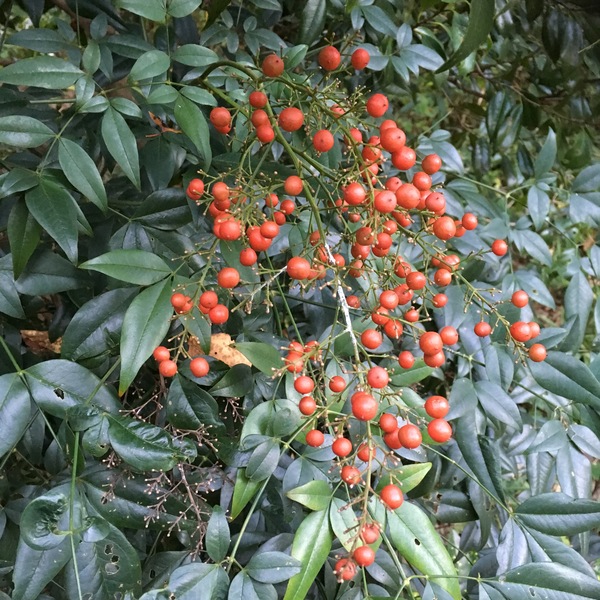
Nandina domestica (nandina, "Nanten")
Japanese name: ナンテン (南天)
Scientific name: Nandina domestica
[Overview]
An evergreen shrub 1–3 m tall, planted as a garden tree.
Rarely, some reach 5–6 m.
The trunks grow in clumps and branch little.
The leaves are alternate, 3-times ternately compound and 30–50 cm long; the leaflets are lanceolate, 2–10 cm long and 0.5–2.5 cm wide, with entire margins.
The leaves are clustered on the upper part of the trunk, and the base of the leaf stalk clasps the stem.
The leaves turn red in autumn.
A large panicle 20–35 cm long at the tip of the trunk bears many flowers.
The flowers are white to cream, 6–7 mm across; the tepals are borne in many sets of three, and the innermost 6 are conspicuous and petal-like.
The fruit is spherical, 6–7 mm across, and ripens red.
[History]
It is not clear whether plants seen in the wild in southwestern Japan are truly native.
The Japanese name is connected with the phrase "nan o tenzuru" (to turn away misfortune), and since ancient times the plant has been used as a charm against evil and bad luck and as an auspicious plant.
It is already mentioned in the Meigetsuki of the Kamakura period, and there are records of its use as a material for landscaping and ikebana (flower arranging) in the Ashikaga period.
In the Edo period many cultivars with variation in leaves and fruit were created, and its cultivation boomed as a traditional horticultural plant.
[Uses]
The fruit is used medicinally.
The tree was believed to prevent food from spoiling and to counteract poison, so its leaves are placed on celebratory red rice (sekihan) and on fish as a charm to turn away the misfortune of food poisoning.
[Cultivation]
Propagate from seed or by cuttings.
Rare cultivars are propagated by grafting.
Wash the pulp off the seeds, store them moist, and sow in the following spring.
The wild type is hardy and easy to grow in well-drained soil.
It is also highly drought tolerant and grows even in fairly damp places.
Plant in sun to partial shade, and avoid places exposed to strong afternoon sun or places that become dry.
It flowers during the rainy season, and fruit set is poor in places where it is continually rained on, so it is good to provide rain protection and hand pollination.
For potted plants, water thoroughly when the soil surface dries; for plants in the ground, rainfall is sufficient.
For plants in the ground, apply organic fertilizer in winter; for potted plants, apply slow-release fertilizer high in phosphorus and potassium when repotting.
Pruned stems do not resprout, so in spring cut stems off at the base to thin them out and encourage new stems to grow.
Pests and diseases include mosaic disease, leaf blight, sooty mold, scale insects and leaf rollers, but damage is usually slight.
Details
Japanese: ナンテン(南天)、ナルテン(成天)
Translated from our Japanese encyclopedia. If anything differs, the Japanese page is correct.