
Plant Encyclopedia

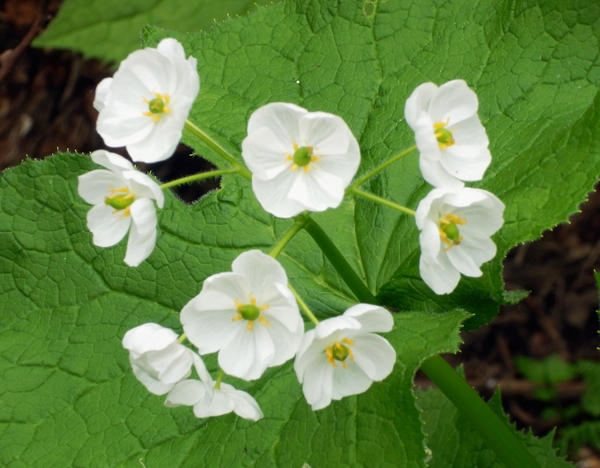
Diphylleia grayi ("Sankayo")
Japanese name: サンカヨウ (山荷葉)
Scientific name: Diphylleia grayi
[Overview]
A perennial 30–60 cm tall, found in moist places in forests and at forest edges.
It has thick rhizomes creeping underground.
Curly hairs grow on the stems and leaves.
Usually only two leaves emerge, alternate; the lower leaf is reniform-orbicular, 20–30 cm long and 30–35 cm wide, 2-lobed, with a long leaf stalk attached peltately.
The upper leaf is smaller than the lower one, with a very short leaf stalk that is not attached peltately.
The leaf margins have incised teeth.
Cymose inflorescences emerge at the stem tip and bear several flowers about 2 cm across.
The flowers have no petals; the white sepals stand out like petals and become transparent when wet with rain.
The fruit is an elliptical berry 1–1.3 cm long, which becomes bluish purple with a whitish bloom when ripe; it is sweet-sour and edible.
[Uses]
The rhizomes are used medicinally.
[Cultivation]
Propagate from seed.
It prefers partial shade to shade and fertile soil that is well drained and retains water well.
For plants in the ground, it is good to plant them under deciduous trees.
For potted plants, from spring to autumn water thoroughly when the soil surface dries, and water sparingly in winter.
For plants in the ground, rainfall is sufficient unless sunny weather continues and the soil dries out.
In early spring, apply slow-release fertilizer placed on the soil.
There are no particular pests or diseases.
Details
Translated from our Japanese encyclopedia. If anything differs, the Japanese page is correct.