
Plant Encyclopedia

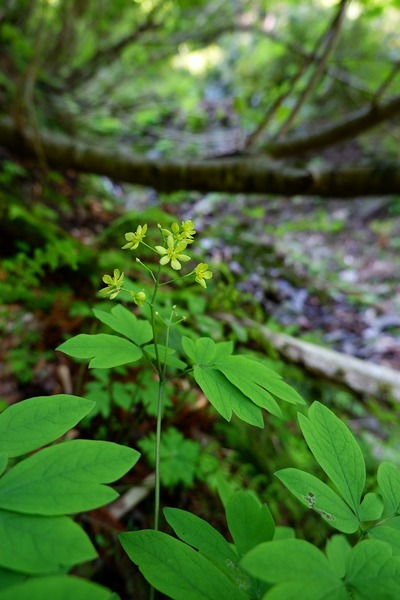
Caulophyllum robustum ("Ruiyobotan")
Japanese name: ルイヨウボタン (類葉牡丹)
Scientific name: Caulophyllum robustum
[Overview]
A perennial 40–70 cm tall, found in deciduous forests such as beech forests in the mountains, often forming small colonies.
The whole plant is hairless.
The underground stem creeps sideways and bears many fibrous roots; the base of the old stem remains each year.
There are no basal leaves, and scales are attached to the base of the stem.
The leaves are usually two in number, alternate, and 2–3 times ternately compound; because the leaf stalks are very short, the compound leaves look as if they were whorled.
The leaflets are thin, oblong, 4–8 cm long and 2–4 cm wide; on large leaves they are 2–3-lobed, and the leaf margins are entire.
Cymose inflorescences emerge from the stem tip or leaf axils and bear about 10 flowers.
The flowers are greenish yellow, 0.8–1 cm across; there are 6 petals, which are small and nectary-like, and the inner sepals look like petals.
There are 3–6 outer sepals, which fall early.
Two seeds form side by side from each flower; the seeds are exposed and become a spherical berry-like structure about 0.8 cm across, ripening blue, with a thick fruit stalk (ovule stalk).
[Uses]
The roots and rhizomes are used medicinally.
[Cultivation]
Propagate from seed, sowing the seeds immediately after harvest.
It prefers partial shade to shade, a well-drained, slightly moist location.
In summer, keep it cool in airy shade.
For plants in the ground, it is good to plant them under deciduous trees.
For potted plants, water thoroughly when the soil surface dries; for plants in the ground, rainfall is sufficient unless sunny weather continues and the soil dries out.
In spring, apply slow-release fertilizer placed on the soil.
There are no particular pests or diseases.
[Notes]
The Japanese name comes from the leaves resembling those of the peony.
Details
Translated from our Japanese encyclopedia. If anything differs, the Japanese page is correct.