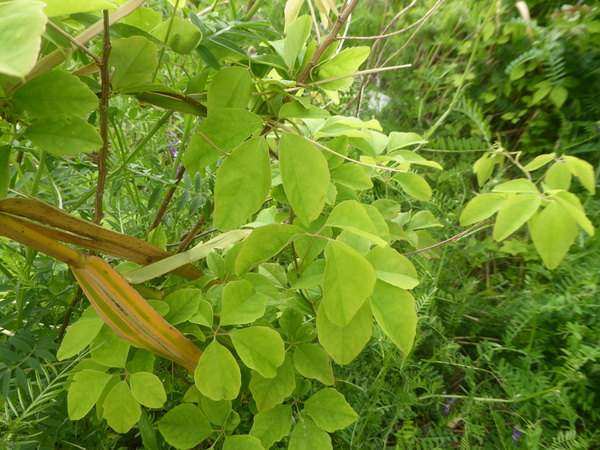
Japanese name: ゴヨウアケビ(五葉通草) Scientific name:Akebia ×pentaphylla var. pentaphylla
[Overview]
A deciduous woody climber that climbs by twining around other plants.
It is thought to be a hybrid of Akebi and Mitsuba-akebi.
The leaves are alternate and palmately compound, usually with 5 leaflets but sometimes 3.
The leaflets resemble those of Mitsuba-akebi, being elliptic with a few wavy teeth.
Racemose or corymbose inflorescences hang down from the new leaves and scale axils of short shoots, bearing male flowers at the tip and female flowers at the base.
The flowers also resemble those of Mitsuba-akebi; they have no petals, and both female and male flowers have 3 purple sepals.
The fruit is a berry, elliptic, 5–10 cm long and tinged with purple; when ripe it splits open to reveal white flesh inside.
[Uses]
The flesh is sweet and can be eaten raw.
The remaining fleshy rind is bitter and can be eaten cooked, for example stuffed with meat.
The young shoots are also used as wild vegetables.
Oil can be extracted from the seeds.
The vines are used for crafts such as woven baskets.
The vines are used as a crude drug.
[Cultivation]
As long as the site is well drained, retains water well and is sunny, it is not very particular about soil.
Propagate by grafting or from seed.
Powdery mildew and aphids are seen as pests and diseases.