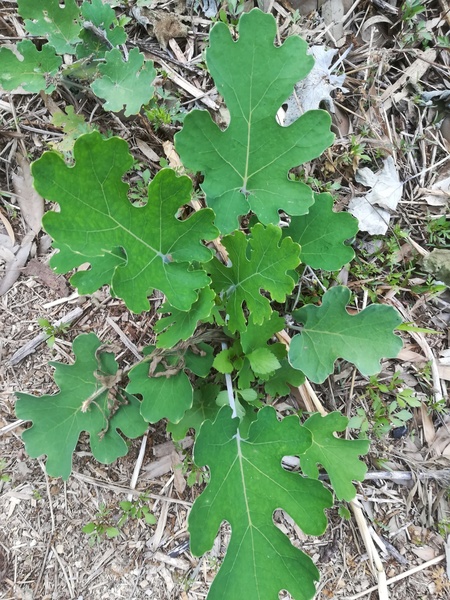
Japanese name: タケニグサ(竹似草、竹煮草) Scientific name:Macleaya cordata
[Overview]
A perennial 1–2 m tall, growing abundantly on poor soils such as sunny wasteland.
It is a so-called pioneer plant.
The stem is thick, cylindrical and hollow, and exudes orange sap when cut.
The leaves are alternate and simple, broadly ovate, 20–40 cm long and 15–30 cm wide, and pinnately lobed to about the middle.
The underside of the leaf is white and densely covered with fine hairs.
Large panicles at the stem tip bear small white flowers without petals; the 2 sepals look like petals.
The fruit is a flattened capsule 2 cm long and 0.5 cm wide.
[Uses]
It is poisonous and has also been used as an insecticide.
[Cultivation]
Propagate from seed.
It grows even if left alone in a sunny, well-drained place.
It becomes a large clump and spreads readily, turning into a weed, so caution is needed.
[Notes]
Theories on the origin of the Japanese name include that the stem resembles Take, and that Take becomes soft when boiled together with this plant.