
Plant Encyclopedia

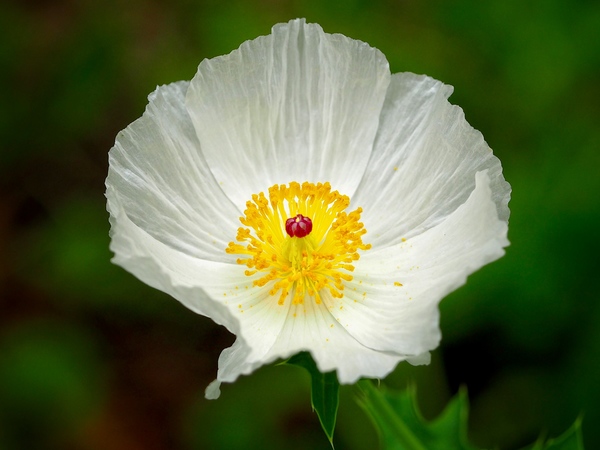
Argemone mexicana (Mexican poppy, "Azamigeshi")
Japanese name: アザミゲシ (薊罌粟)
Scientific name: Argemone mexicana
[Overview]
An annual about 30–60 cm tall.
In its native range it is found in arid regions.
Orange sap comes out when the stem or leaves are damaged.
The leaves are simple and alternate; those on the lower part of the stem are pinnately lobed to about the middle, and those on the upper part are shallowly lobed.
The leaves have white markings along the veins.
The leaf margins have sharp, strong spines.
The leaves on the upper part of the stem clasp the stem at the base.
A single flower is borne at the tip of the stem.
The flowers are about 7 cm across, yellow, with 4–6 petals.
The petals fall easily.
There are many stamens, and the stigma spreads radially.
The calyx has sharp spiny projections.
The fruit is a spiny capsule.
[History]
It arrived in Japan at the end of the Edo period.
[Uses]
The seeds are used medicinally.
In its native range the whole plant is traditionally used as medicine.
[Cultivation]
Propagate from seed.
It multiplies readily from self-sown seed.
It has a taproot and dislikes transplanting, so sow directly.
It prefers a sunny, well-drained, dry site.
It is resistant to dryness and weak against heat and humidity, so water after the soil has dried.
There are no particular pests or diseases.
[Notes]
The Japanese name comes from its being a poppy whose leaves resemble those of the thistle (azami).
Details
Japanese: アザミゲシ(薊罌粟)
Translated from our Japanese encyclopedia. If anything differs, the Japanese page is correct.